What Is TDEE? How to Calculate Yours
TL;DR. What is TDEE? Total Daily Energy Expenditure is the total number of calories you burn in a day — your resting metabolism plus the energy for digestion, exercise, and everyday movement. Most people calculate it by running the Mifflin-St Jeor equation to get their BMR, then multiplying by an activity factor between 1.2 and 1.9. A lightly active 30-year-old woman at 68 kg and 165 cm lands near 1,900 calories; an active man her age can clear 2,800. That single number is the anchor for every calorie goal — cut below it to lose weight, eat above it to gain.
If you've ever plugged your stats into a calculator, gotten a number, and had no idea what it actually meant, you're in the right place. TDEE is the most useful number in nutrition, and almost every calorie target you'll ever set traces back to it. But the calculator pages that dominate search rarely explain where the number comes from or how to use it. This guide does the teaching part properly, then hands you off to the interactive TDEE calculator when you're ready to run your own.
What TDEE stands for and its 4 components
TDEE stands for Total Daily Energy Expenditure. It's the sum of every calorie your body burns in 24 hours, across four components. Understanding the parts matters, because most of the confusion around calorie counting comes from people conflating one component with the whole.
Basal Metabolic Rate (BMR). This is the energy your body uses at complete rest just to stay alive — breathing, circulating blood, keeping your organs and brain running. BMR is the biggest slice by far, accounting for roughly 60 to 70% of your total daily burn. Even on a day you never leave bed, your body spends this.
Thermic Effect of Food (TEF). Digesting and processing what you eat costs energy. TEF is usually around 10% of your daily total, and it varies by macronutrient — protein has the highest thermic effect, which is one reason higher-protein diets feel slightly more "expensive" metabolically.
Exercise Activity Thermogenesis (EAT). This is the energy of deliberate exercise: your run, your lifting session, your yoga class. A running calorie calculator shows roughly what a typical run adds. For most people EAT is smaller than they assume — a single hour of moderate exercise rarely moves the total as much as a full day of general activity does. Plug an hour of laps into the swimming calorie calculator and compare it with your TDEE to see the gap.
Non-Exercise Activity Thermogenesis (NEAT). Everything else you do while awake and moving — walking to the mailbox, standing, cooking, fidgeting, taking the stairs. NEAT is the most variable component between people, and it's often the reason two people with identical BMRs burn very different amounts. Someone with a physical job can burn hundreds more calories a day than a desk worker without a single "workout." Research on NEAT by James Levine and colleagues found it can vary by up to 2,000 calories a day between people of the same weight.
Add those four together and you have your TDEE. The activity multiplier in the standard formula is just a shortcut. It bundles EAT and NEAT on top of your BMR and TEF.
That's also why two calculators can hand you slightly different numbers. Each one is making an educated guess about how much of your day is movement. No single multiplier fits a real person perfectly. What the framework gives you is a reliable starting estimate — precise enough to plan with, loose enough that you'll want to check it against the scale.
One more term worth knowing: BMR is sometimes used interchangeably with RMR (Resting Metabolic Rate). The two are measured a little differently. BMR is taken under strict fasted, fully rested lab conditions. RMR is a looser, more practical measure. The difference is small, so for everyday planning you can treat them as the same.
BMR vs TDEE: the difference
This is the distinction that trips up the most people, so it's worth being precise.
BMR is what you burn at rest. It's the floor — the calories your body would spend lying still all day. On its own, BMR is not a calorie target. If you ate only your BMR while living a normal, moving life, you'd be in a steep deficit.
TDEE is what you actually burn living your life. It takes BMR and adds the energy of digestion, exercise, and movement. TDEE is always higher than BMR, usually by 20 to 90% depending on how active you are.
Here's the practical version: BMR answers "how much do I burn doing nothing?" and TDEE answers "how much do I burn doing my actual day?" Your calorie goals should be built around TDEE, not BMR. People who accidentally set their target at or below their BMR often lose weight fast at first, then feel exhausted and stall — because they've cut far deeper than they realized.
There's a body-composition angle here too. Muscle is more metabolically active than fat. So two people at the same weight can have different BMRs if one carries more muscle. That's why strength training pays off twice: it burns calories during the session, and it nudges your resting metabolism up over time. Want to see how your own composition factors in? The body fat calculator estimates your lean mass, which is the part that actually drives BMR.
If you want to see both numbers side by side for your own stats, the TDEE calculator shows your BMR and your activity-adjusted total together.
How to calculate TDEE (the Mifflin-St Jeor formula)
Calculating TDEE is a two-step process: find your BMR, then multiply by an activity factor.
Step 1: Calculate your BMR with the Mifflin-St Jeor equation.
The Mifflin-St Jeor equation, published by M.D. Mifflin, S.T. St Jeor, and colleagues in the American Journal of Clinical Nutrition in 1990, is the modern standard for estimating BMR. It was built from resting energy measurements in 498 healthy adults, and in that same study the older Harris-Benedict equation from 1919 overestimated measured resting energy by about 5%. It uses your weight in kilograms, height in centimeters, and age in years:
- Men: BMR = (10 × weight) + (6.25 × height) − (5 × age) + 5
- Women: BMR = (10 × weight) + (6.25 × height) − (5 × age) − 161
Worked example — a 30-year-old woman weighing 68 kg at 165 cm:
BMR = (10 × 68) + (6.25 × 165) − (5 × 30) − 161 = 680 + 1,031 − 150 − 161 = 1,400 calories.
Step 2: Multiply your BMR by your activity factor.
Your BMR only covers rest. To get your full TDEE, multiply it by a factor that reflects how much you move — from 1.2 for a mostly sedentary life up to 1.9 for very high activity. If our example woman is lightly active (BMR 1,400 × 1.375), her TDEE is about 1,925 calories a day.
That's the whole calculation. Running it by hand once is worth doing so you understand the moving parts, but for repeat use — or to skip the arithmetic — the TDEE calculator does both steps instantly, and the macro calculator turns your result into protein, carb, and fat targets.
Activity multiplier table (sedentary to very active)
Choosing your activity multiplier is where most people go wrong, so pick honestly. The table below shows each level, its multiplier, and an example TDEE built on a 1,600-calorie BMR so you can see how much the choice swings the final number.
| Activity level | Description | Multiplier | Example TDEE (BMR 1,600) |
|---|---|---|---|
| Sedentary | Desk job, little or no exercise | 1.2 | 1,920 |
| Lightly active | Light exercise 1–3 days/week | 1.375 | 2,200 |
| Moderately active | Moderate exercise 3–5 days/week | 1.55 | 2,480 |
| Very active | Hard exercise 6–7 days/week | 1.725 | 2,760 |
| Extra active | Physical job or twice-daily training | 1.9 | 3,040 |
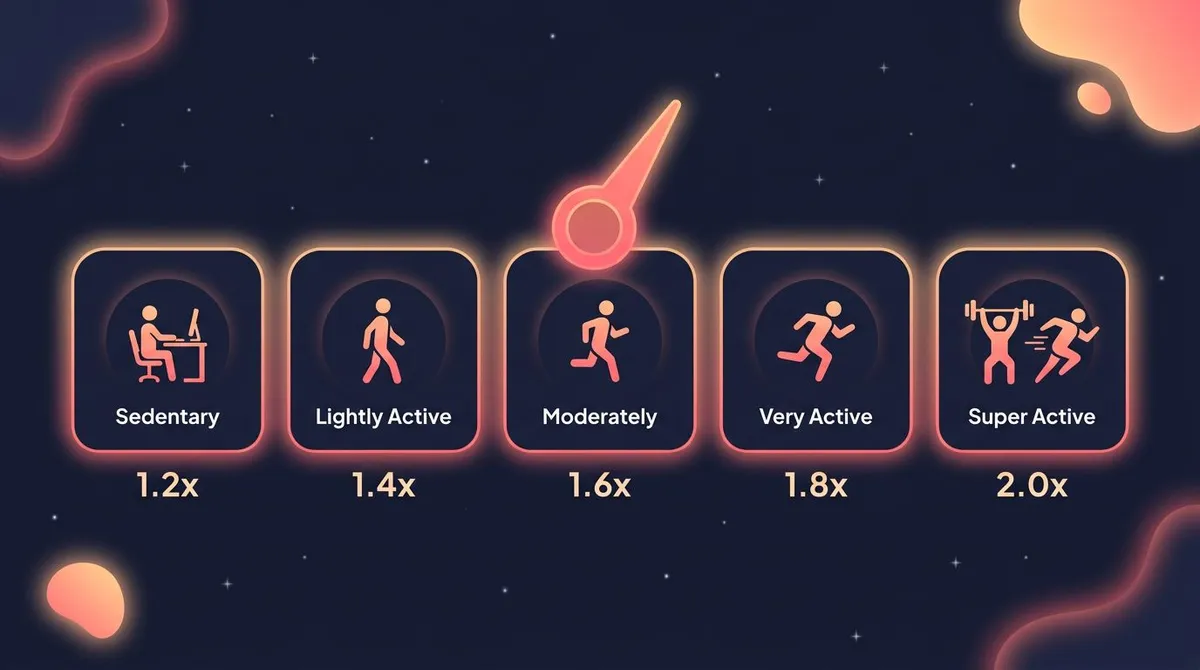
Notice the spread: the same person could calculate anywhere from 1,920 to 3,040 calories depending only on which row they pick. That 1,100-calorie gap is why overestimating activity is the single most common TDEE mistake — more on that below.
How to use your TDEE for weight loss, gain, or maintenance
Once you have your TDEE, using it is refreshingly simple. Your goal determines which side of the number you eat on.
To lose weight, eat below your TDEE. A daily deficit of around 500 calories is a common starting point, so if your TDEE is 2,400, a target around 1,900 is a reasonable cut. You'll often hear that a pound of body fat holds roughly 3,500 calories, so that deficit should add up to about a pound a week. Treat that as a rough approximation, not a forecast: as you lose weight your body burns less, so the 3,500-calorie rule overestimates how much you'll lose over the long run. A 2011 Lancet analysis led by NIH researcher Kevin Hall found that bodyweight responds slowly to a lasting change in eating, taking about a year to reach half of the eventual change. For a more realistic timeline based on your own numbers, the NIH's free Body Weight Planner is built on that research. Deeper deficits lose faster but get harder to hold and eat into energy, sleep, and muscle. If you're planning significant weight loss or have a health condition, work out your plan with a doctor or registered dietitian. Movement helps too — even something as simple as walking 10,000 steps a day raises your NEAT and widens the deficit without extra hunger.
To gain weight, eat above your TDEE. A surplus of 250 to 500 calories a day supports steady gain. Pair it with resistance training so more of that gain is muscle rather than fat — a surplus alone just adds weight, not necessarily the kind you want. The eating target only works if the training is consistent, which is really a habit problem; the tactics in our guide on how to make exercise a habit apply directly here.
To maintain, eat at your TDEE. This is the "recomp" or hold zone. Eat around your number, keep protein high, and your weight stays roughly stable while training slowly shifts your body composition. Maintenance is also the smart place to start if you're new to tracking — spend two weeks eating at your estimated TDEE and watching the scale, and you'll learn whether your real number is higher or lower than the formula guessed before you ever try to cut or bulk.
Whichever direction you're heading, protein is the macro to anchor first. A common target is 0.7 to 1 gram of protein per pound of bodyweight, which protects muscle in a deficit and builds it in a surplus. The macro calculator splits your TDEE-based calorie target into protein, carbs, and fat so you're not just hitting a calorie number but eating in a way that supports your goal.
The catch: your TDEE is an estimate, not a lab measurement. Treat the calculated number as a starting point. Eat at that target for two to three weeks, track your weight trend, and adjust by 100 to 200 calories based on what the scale actually does. Real-world feedback beats any formula. This is where a daily tracking habit earns its keep — logging your intake, steps, or workouts consistently gives you the data to fine-tune. A simple tracker like HabitBox makes it easy to check off "logged calories" or "hit step goal" each day, so the habit that feeds your TDEE target actually sticks.
Common TDEE mistakes to avoid
Two errors account for most of the frustration people have with calorie targets.
Overestimating your activity level. Almost everyone picks a multiplier one notch too high. Three gym sessions a week does not make you "very active" — a desk job plus a few workouts is usually "lightly" or "moderately active" at most. As the table above showed, jumping one row can inflate your target by hundreds of calories, which quietly erases a deficit. When in doubt, choose the lower level; you can always eat more if the scale doesn't move.
Not recalculating after your weight changes. TDEE isn't fixed. As you lose weight, your BMR drops because there's less of you to maintain, so your TDEE falls too. The deficit that worked at your starting weight shrinks as you go — this is a big reason weight loss stalls. Recalculate every 10 to 15 pounds of change, or whenever progress flattens for a couple of weeks, and reset your target.
A few smaller traps: forgetting that alcohol and cooking oils add up fast, trusting fitness-tracker calorie burns (their estimates can be far off), and expecting the formula to be exact. Your TDEE is a smart starting estimate. The scale, tracked over weeks, is the real judge — which is why pairing your number with a consistent workout and habit tracking routine works better than recalculating obsessively.
FAQ
What does TDEE stand for?
What is the difference between BMR and TDEE?
How do I calculate my TDEE?
How accurate is a TDEE calculator?
How do I use TDEE to lose weight?

Mira Hartwell
Editor, HabitBoxEditor at HabitBox. Writes about habit science and productivity, grounding every post in named research (Lally, Wood, Walker, Huberman) instead of recycled advice. Read full bio →