How Long to Break a Habit? The Real Number (2026)
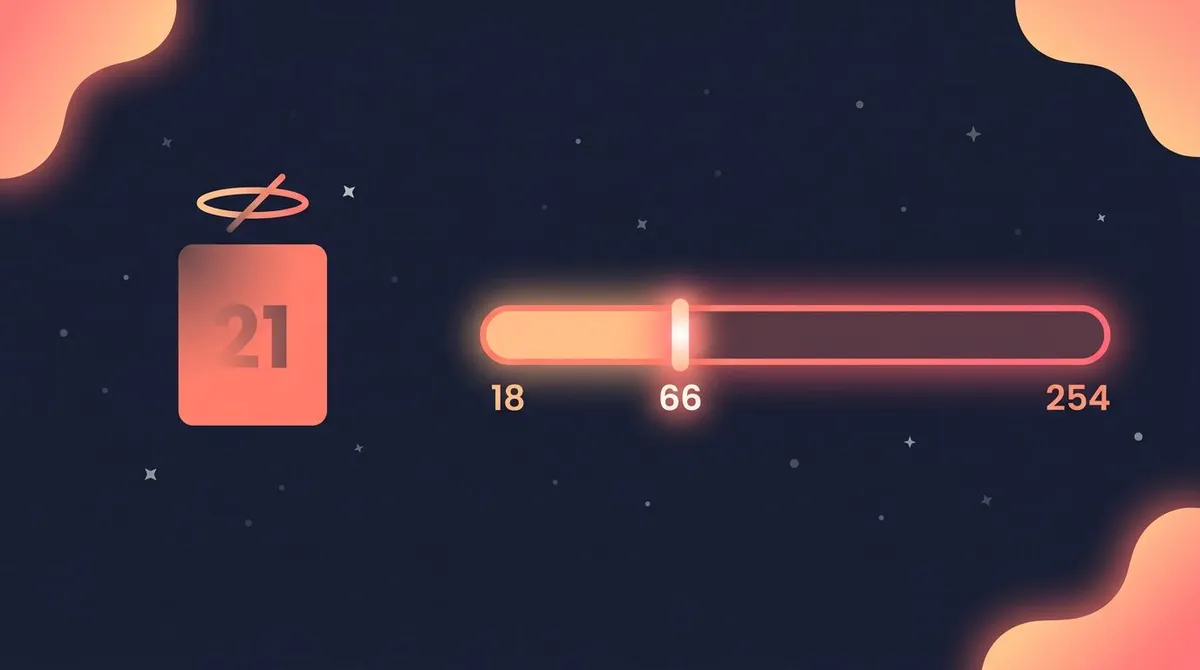
So, how long to break a habit? There's no magic 21 days. The most-cited research (Lally et al., UCL, 2009) found new habits take a median of 66 days to become automatic, with a range of 18 to 254 days. Breaking an old habit is less studied, and the honest answer is that it depends on how strong the cue is, how long you've had the habit, and what you put in its place. Most people should plan for two to three months, not three weeks.
That two-to-three-month window frustrates a lot of people, because the internet keeps promising 21 days. The good news is that the real timeline is more forgiving than it sounds — automaticity builds gradually, and a single missed day doesn't reset the clock. Here's what the research actually says, where the 21-day myth came from, and how to shorten your own timeline.
The short answer: how long to break a habit
There's no single number, because "breaking a habit" hasn't been measured as cleanly as forming one. The closest reliable data comes from habit formation studies, which give us a useful benchmark: roughly two to three months for a behavior to stop feeling like a conscious choice.
Here's the realistic range, pulled from the research most often cited on this topic.
| Estimate | Source | What it actually measures |
|---|---|---|
| 21 days | Maxwell Maltz, Psycho-Cybernetics (1960) | Adjusting to plastic surgery — not breaking habits |
| 66 days (median) | Lally et al., UCL (2009) | Days for a new habit to become automatic |
| 18–254 days (range) | Lally et al., UCL (2009) | Individual variation in the same study |
The takeaway: plan for around a median of 66 days, expect anywhere from a few weeks to the better part of a year, and treat 21 days as a motivational starting point rather than a finish line.
How long common habits take to break
The research gives us a median, but lived experience varies by what you're trying to break. Habits tied to a chemical reward or a strong emotional cue sit at the slow end of the range. Simple behavioral tics tied to a single context tend to fade faster.
The table below is a practical guide, not a clinical guarantee. It maps everyday habits to where they typically fall along the 18-to-254-day range, based on how strong the cue and reward usually are.
| Habit type | Typical timeline | Why |
|---|---|---|
| Mindless phone checking | A few weeks to ~2 months | Cue-driven, but the reward is mild and easy to replace |
| Snacking out of boredom | ~1–2 months | Strong cue (downtime), but a swap satisfies it |
| Nail biting / fidgeting | ~1–3 months | Often automatic and stress-linked, so the cue is frequent |
| Hitting snooze | A few weeks | Single daily cue — easy to disrupt by moving the alarm |
| Sugar or caffeine reliance | 2–3+ months | Physical reward makes the loop sticky |
| Smoking / nicotine | 3+ months, often longer | Strong chemical reward plus many emotional cues |
If your habit isn't on this list, place it by asking two questions: how strong is the reward, and how often does the cue fire? The stronger and more frequent, the longer you should plan for.
Where the 21-day myth came from
The 21-day rule traces back to Dr. Maxwell Maltz, a plastic surgeon who wrote the 1960 self-help book Psycho-Cybernetics. Maltz noticed that his patients seemed to take "about 21 days" to get used to a new face after surgery, or to stop feeling a phantom limb after an amputation.
That's the key detail almost every "21 days" article gets wrong. Maltz was describing habituation — adjusting to something new — not breaking an ingrained behavior. He also based it on informal patient observation, not a controlled study.
His phrasing was cautious: "a minimum of about 21 days." Over the following decades, self-help authors quietly dropped the "minimum" and the "about," and a soft observation hardened into a hard rule. By the time it reached productivity blogs, "21 days to break a habit" sounded like settled science. It never was.
What the real study found
The most rigorous number we have comes from Phillippa Lally and colleagues at University College London, published in the European Journal of Social Psychology in 2009. They asked 96 people to adopt a new daily habit — like drinking water with lunch or going for a walk — and tracked how automatic it felt over 12 weeks.
The result: a median of 66 days for a behavior to reach peak automaticity. But the range was enormous — 18 to 254 days, depending on the person and the habit. Drinking a glass of water became automatic fast; doing 50 sit-ups took far longer.
Two findings matter most for anyone trying to break a habit:
- Missing a single day didn't derail anyone. One lapse had no measurable effect on long-term habit strength, which is reassuring if you're worried about "ruining" a streak.
- Harder behaviors took longer. The more effort a habit required, the further out its automaticity point landed.
Note the important caveat the brief insists on: 66 days is the median for forming a habit. Breaking one is a related but distinct process, and it hasn't been measured as precisely. Use 66 as a benchmark, not a guarantee.
Why breaking a habit is harder than forming one
When you form a habit, you're building a new neural pathway from scratch. When you break one, the old pathway is still there — you're competing against it.
Charles Duhigg, in The Power of Habit (2012), describes every habit as a loop: a cue triggers a routine, which delivers a reward. You can't easily delete that loop. The cue keeps firing — the time of day, the stress, the location, the social setting — and your brain keeps expecting the reward.
That's why willpower alone tends to fail. The cue doesn't disappear just because you've decided to quit. This is also why replacement beats pure elimination: instead of leaving a gap where the old routine was, you keep the cue and the reward but swap the routine in the middle. James Clear makes the same point in Atomic Habits (2018) — make the bad habit harder and the good one easier, rather than relying on motivation to override the loop.
In practice, an old habit's cue can keep showing up for weeks after the behavior stops. That doesn't mean you're failing — it means the loop is still extinguishing. The urge fades a little each time you don't act on it.
5 factors that change your timeline
Two people quitting the same habit can land months apart. Here's what tilts the timeline faster or slower.
| Factor | Faster to break | Slower to break |
|---|---|---|
| Habit age | A few weeks or months old | Years of repetition |
| Cue strength | Weak, occasional triggers | Strong, frequent, emotional triggers |
| Reward intensity | Mild payoff | Strong chemical or emotional reward |
| Replacement | A clear new routine is ready | No substitute — just a void |
| Environment | Triggers removed or changed | Same cues surround you daily |
The single most controllable factor is environment. You can't always weaken a craving, but you can often remove the cue — and a cue that never fires can't start the loop.
How to shorten the timeline
You can't skip the work, but you can stop fighting the loop the hard way. These four moves do most of the heavy lifting.
- Remove the cue. Change your route, hide the trigger, mute the notification. Harvard Health's guide to breaking a bad habit gives the same advice, down to changing your route — the easiest urge to resist is the one that never starts.
- Install a replacement. Keep the cue and the reward, swap the routine. Almonds instead of candy. A walk instead of a scroll. The gap is what makes quitting fragile.
- Ride out the urge. Harvard Health notes that a craving usually peaks and fades within about 20 minutes. Set a timer, change rooms, hold an ice cube — just get through the wave.
- Track days-since. Watching a number climb turns an invisible process into visible progress. A tracker like HabitBox can show your days-since count and current streak, so two slow months feel like momentum instead of a slog.
Pick one habit at a time. Stacking three quit attempts at once spreads your attention thin and makes every one of them more likely to fail.
If you want to dig deeper into the mechanics, see our guides on how to break a habit step by step, the habit loop behind every behavior, and the 4 laws of behavior change. For the other side of the coin — building something new — read how many days to make a habit and our overview of habit formation.
FAQ
Does it really take 21 days to break a habit?
How long does it take to break a bad habit?
Is it harder to break or form a habit?
What's the longest a habit takes to break?
How can I break a habit faster?

Mira Hartwell
Editor, HabitBoxEditor at HabitBox. Writes about habit science and productivity, grounding every post in named research (Lally, Wood, Walker, Huberman) instead of recycled advice. Read full bio →