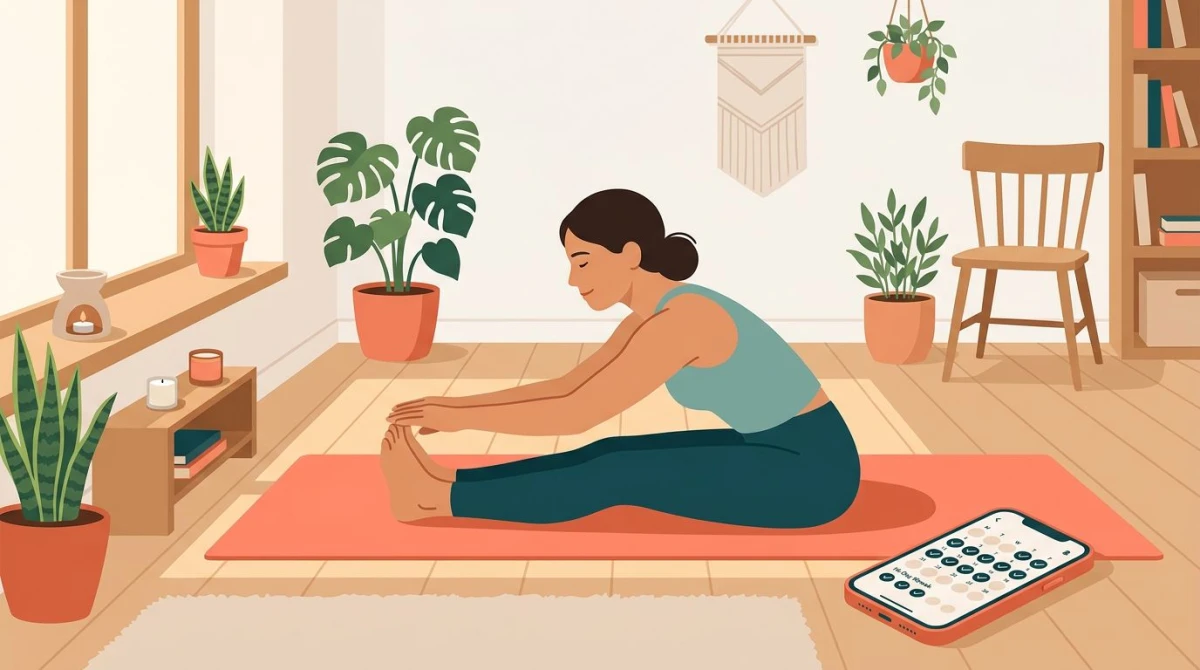
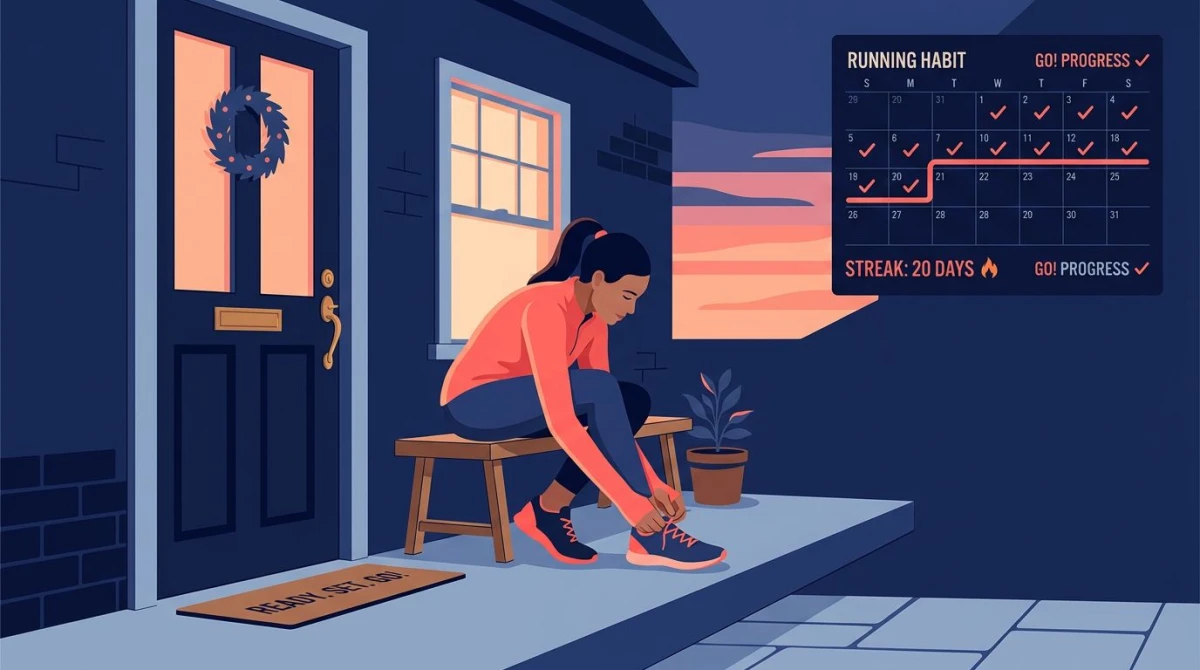
Stretching Routine for Beginners: 10-Min Daily Habit
A stretching routine for beginners works best when it is short, daily, and tied to something you already do. Ten minutes a day, eight named stretches, and a clear cue — that is the entire plan. Most people quit stretching not because the moves are hard but because the habit has no anchor. The routine below fixes the anchor problem first, then teaches the moves.
TL;DR
A 10-minute beginner stretching routine done daily can improve range of motion within four weeks, but only if you protect the cue. Stretch after coffee, after brushing your teeth, or after the laptop closes — never at a clock time. Eight stretches cover the muscles a desk-bound day shortens most: cat-cow, child's pose, doorway chest stretch, hamstring, hip flexor, neck rolls, seated spinal twist, calf stretch. Hold each one for 20 to 30 seconds. Track the streak, not the depth of the stretch.
What is a beginner stretching routine?
A beginner stretching routine is a short, low-intensity flexibility session designed for people who do not stretch yet — or who have tried and stopped. The point is not to touch your toes by next Tuesday. The point is to put a small dose of mobility into the day, every day, until it feels weird to skip it.
Beginner means three things in practice. The session is short (10 minutes or less). The stretches are static or gentle dynamic moves, never deep yoga poses or partner-assisted holds. And the goal is consistency, not depth. A beginner who stretches lightly for 28 days in a row will gain more usable range of motion than someone who does an intense 60-minute session twice and then quits.
That last point matters. Behm and Chaouachi's well-cited 2011 meta-analysis in the European Journal of Applied Physiology on acute effects of muscle stretching found that flexibility gains track with cumulative weekly volume, not with how aggressive any one session is. Short and frequent beats long and rare.
The science: why a daily stretching habit changes your body
Three things happen when you stretch the same muscle every day for several weeks. The first is mechanical — the muscle and connective tissue lengthen slightly. The second is neurological — your nervous system learns to tolerate the lengthened position without firing a protective contraction. The third is behavioral — you start associating the stretch with a specific moment in your day, and the cue takes over the work that motivation used to do.
The mechanical change is the smallest of the three, surprisingly. Research summarized by Harvard Health on the importance of stretching describes flexibility as a use-it-or-lose-it tissue property. Sit at a desk for ten hours and your hip flexors shorten. Stretch them daily and they hold their length. Stop stretching for a month and they go back. Stretching is maintenance, not an upgrade you install once.
The neurological change is what most beginners feel first. The first time you reach for a hamstring stretch, your nervous system reads it as a threat and tightens the muscle to protect it. After two or three weeks of daily practice, the same depth feels easy. You did not "get more flexible" in the sense of growing new tissue. Your nervous system stopped sounding the alarm. Behm and Chaouachi's review notes that this stretch tolerance shift accounts for most of the perceived gains in the first month.
The behavioral change is the one nobody talks about, and it is the one that matters most. BJ Fogg, founder of the Stanford Behavior Design Lab, wrote in Tiny Habits that new behaviors stick when they are anchored to an existing routine, not to a clock. A 7 AM stretching alarm fails because you can dismiss it. A stretch right after the coffee maker beeps does not fail in the same way — the cue is already happening whether you cooperate or not.
James Clear builds the same idea into the habit stacking formula in Atomic Habits: "After [current habit], I will [new habit]." Stretching is a near-perfect candidate for this formula because it needs no equipment, no change of clothes, and no warm-up. You can do every stretch in this guide in pajamas, on a carpet, in your bedroom or living room.
Static vs dynamic: which type of stretching belongs in a beginner routine?
There are two main families of stretches a beginner needs to know. Static stretches involve holding a position for 20 to 60 seconds — think of reaching for your toes and staying there. Dynamic stretches involve moving through a range of motion repeatedly, like leg swings or arm circles.
For a beginner daily routine, static and gentle dynamic stretches are the right tool. Aggressive dynamic stretches and ballistic bouncing moves are reserved for athletes warming up before sport. They are not what you need at 7 AM on a Tuesday.
A common confusion: should you stretch before or after a workout? The current consensus, summarized in CDC guidance on physical activity basics, is that dynamic stretches go before exercise (they wake the muscles up) and static stretches go after (they help recovery and lengthen). For a standalone daily mobility routine that is not attached to a workout, static stretches are fine and there is no warm-up requirement beyond gentle starting movements like cat-cow.
The eight stretches below mix mostly static holds with two gentle dynamic moves (cat-cow and neck rolls) so the routine is safe to do cold, first thing in the morning.
The 8 beginner stretches: a comparison table
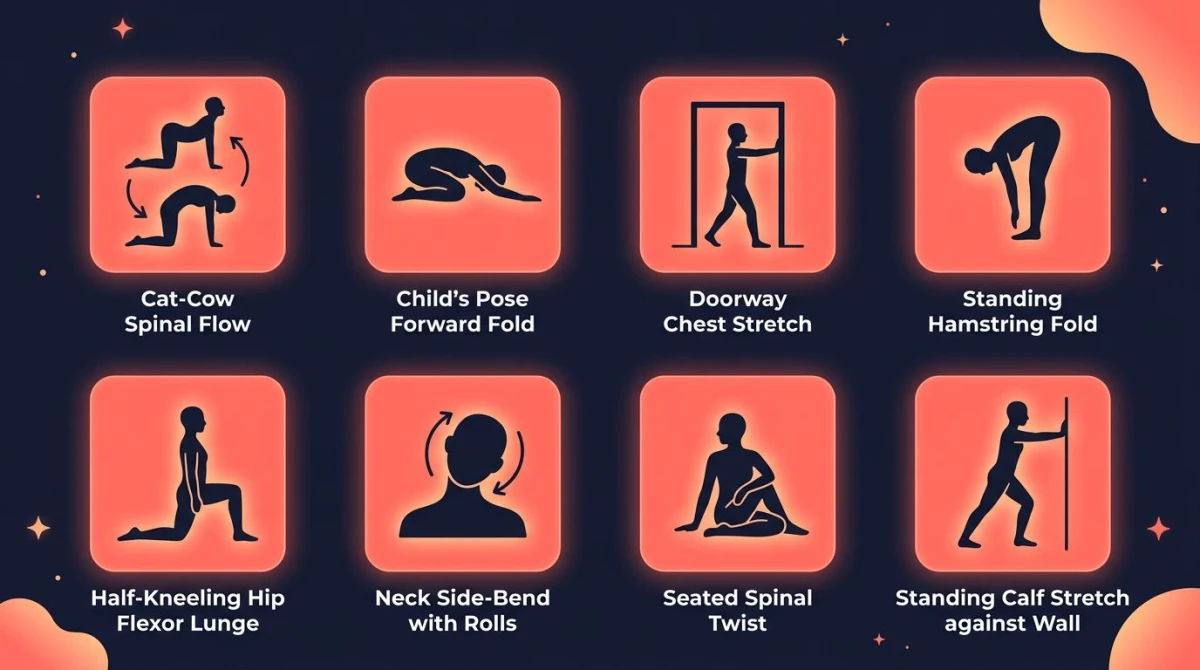
These eight stretches cover the body parts a typical sedentary day shortens most: spine, chest, hamstrings, hip flexors, neck, shoulders, glutes, and calves. You can do every one on a yoga mat or carpet. No equipment beyond a doorway for the chest stretch.
| Stretch | Target muscle | Hold time | Difficulty |
|---|---|---|---|
| Cat-cow | Spine, back | 30 sec (slow flow) | Easy |
| Child's pose | Lats, lower back | 30 sec | Easy |
| Doorway chest stretch | Pecs, front shoulders | 30 sec each side | Easy |
| Standing hamstring stretch | Hamstrings | 30 sec each leg | Easy |
| Half-kneeling hip flexor | Psoas, quads | 30 sec each leg | Moderate |
| Neck rolls + side bends | Neck, traps | 30 sec total | Easy |
| Seated spinal twist | Obliques, mid-back | 30 sec each side | Easy |
| Standing calf stretch | Calves, achilles | 30 sec each leg | Easy |
That is roughly 4 minutes of pure hold time. Add transitions and a slow pace, and the full routine fits inside 10 minutes.
How to do each stretch
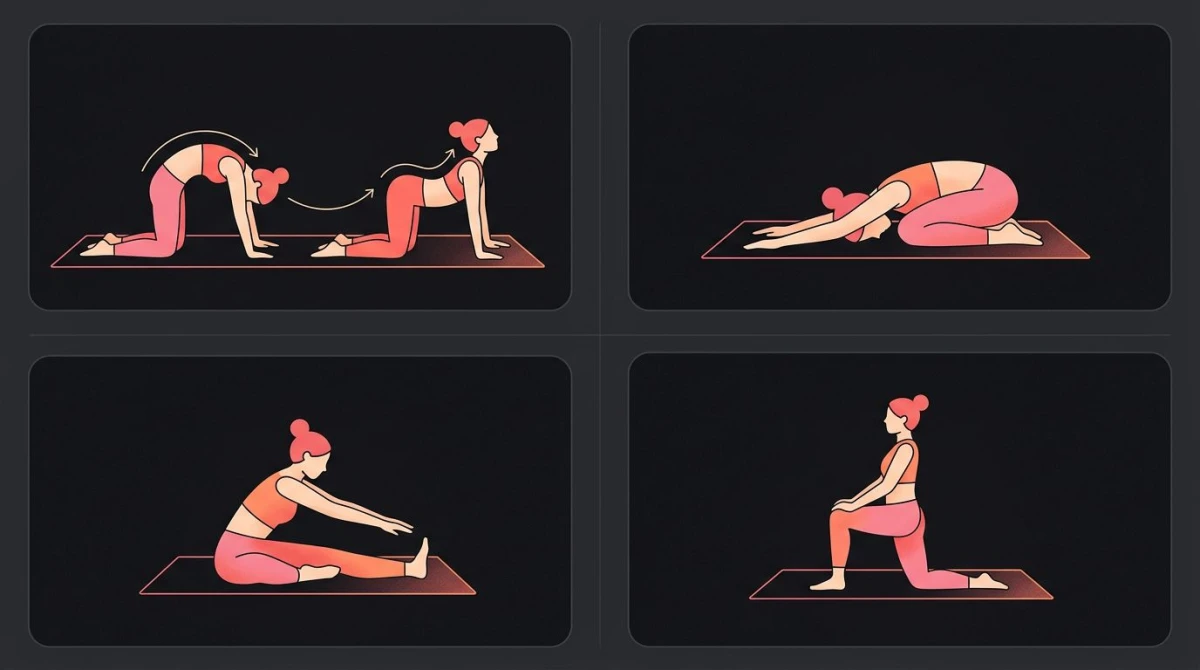
Cat-cow. Start on hands and knees, hands under shoulders, knees under hips. Inhale and drop your belly toward the floor while looking up — that is "cow." Exhale and round your spine toward the ceiling, tucking your chin — that is "cat." Slow flow for 8 to 10 cycles. This wakes up the spine and is the perfect first move from a stiff morning state.
Child's pose. From the hands-and-knees position, sit your hips back onto your heels and reach your arms forward along the floor. Forehead toward the mat. If your hips do not reach your heels, that is fine — keep the shape and breathe. Hold 30 seconds. This stretches the lats, lower back, and the entire posterior chain.
Doorway chest stretch. Stand in a doorway. Place one forearm against the door frame, elbow at shoulder height. Step the same-side foot forward and gently lean into the door frame until you feel a stretch across your chest. Hold 30 seconds. Switch sides. Desk workers feel this one immediately — the pectoral muscles shorten from typing posture, and this is the cheapest fix.
Standing hamstring stretch. Stand tall. Step one foot forward with the heel on the floor and toes up. Bend the back knee slightly and hinge at the hips, sliding your hands down the front leg. Stop when you feel a stretch behind the knee or in the hamstring. Keep the back flat — do not round to chase depth. Hold 30 seconds. Switch.
Half-kneeling hip flexor stretch. Drop into a half-kneeling lunge: one knee on the floor, the other foot in front with knee at 90 degrees. Tuck the tailbone slightly and squeeze the back glute. Lean forward an inch. You should feel a stretch on the front of the hip of the back leg. Hold 30 seconds. Switch. This is the single most important stretch for anyone who sits more than four hours a day.
Neck rolls and side bends. Sit or stand tall. Slowly drop your right ear toward your right shoulder. Hold 5 seconds. Bring your head back to center. Drop chin toward chest, hold. Drop left ear to left shoulder, hold. Then add gentle side bends with the opposite arm reaching overhead. Spend 30 seconds total here. Skip the full neck circle — the back-of-neck portion is harder on cervical joints than people realize.
Seated spinal twist. Sit on the floor with both legs extended. Bend your right knee and place the right foot outside the left thigh. Place your right hand on the floor behind you and your left elbow on the outside of your right knee. Inhale tall, exhale into the twist. Hold 30 seconds. Switch.
Standing calf stretch. Stand facing a wall, arms length away. Place hands on the wall. Step one foot back, keeping that heel pressed into the floor and the back leg straight. Lean toward the wall until you feel a stretch in the back calf. Hold 30 seconds. Switch.
That is the full body. Eight stretches, ten minutes, no equipment.
How to actually build the stretching habit
The stretches are not the hard part. The hard part is doing them on day 14 when nothing has visibly changed and the novelty is gone.
If you'd rather follow along with a video for the first week, this 10-minute total-body routine hits the same muscle groups as the list above and is a clean drop-in for the daily slot:
Here is the framework that works for most beginners.
1. Pick a visible anchor, not a time
Time-based cues are fragile. A 7 AM stretching reminder competes with the snooze button, with breakfast, with the phone, with everything else demanding the first ten minutes of your day. It will lose most days.
A behavioral anchor is different. It happens automatically, regardless of your motivation level. Good anchors for stretching include:
- After the coffee maker finishes brewing
- After you brush your teeth in the morning
- After your laptop closes at the end of the workday
- After the kids go to bed
- After you change into pajamas
Pick one. Write it down as a sentence: "After my coffee is poured, I will do my 10-minute stretch routine on the living room rug." That sentence is your contract.
2. Reduce friction to almost zero
If you have to find your yoga mat, clear the room, and change clothes, you will skip. Solve this on day one.
Leave the mat unrolled in the spot where you will stretch. Or skip the mat — a carpet or rug works. Wear whatever you slept in, or whatever you wear at home. The goal of a beginner stretching routine is to put no decision between the cue and the stretch.
3. Start with five stretches, not eight
Even though the full routine is eight moves, week one should be five. Pick the five that target the parts of your body you feel most tight in — for most desk workers, that is hamstrings, hip flexors, chest, child's pose, and neck. Five stretches is six minutes. That is a much smaller commitment to defend on a tired Tuesday.
Add the remaining three in week two, once the cue is locked in.
4. Track the streak, not the depth
How deep you can fold today is the wrong metric. Whether you showed up today is the right metric. Stretching depth fluctuates daily — sleep, hydration, room temperature, and stress all change how a hamstring feels. If you measure depth, you will get discouraged on bad days and quit.
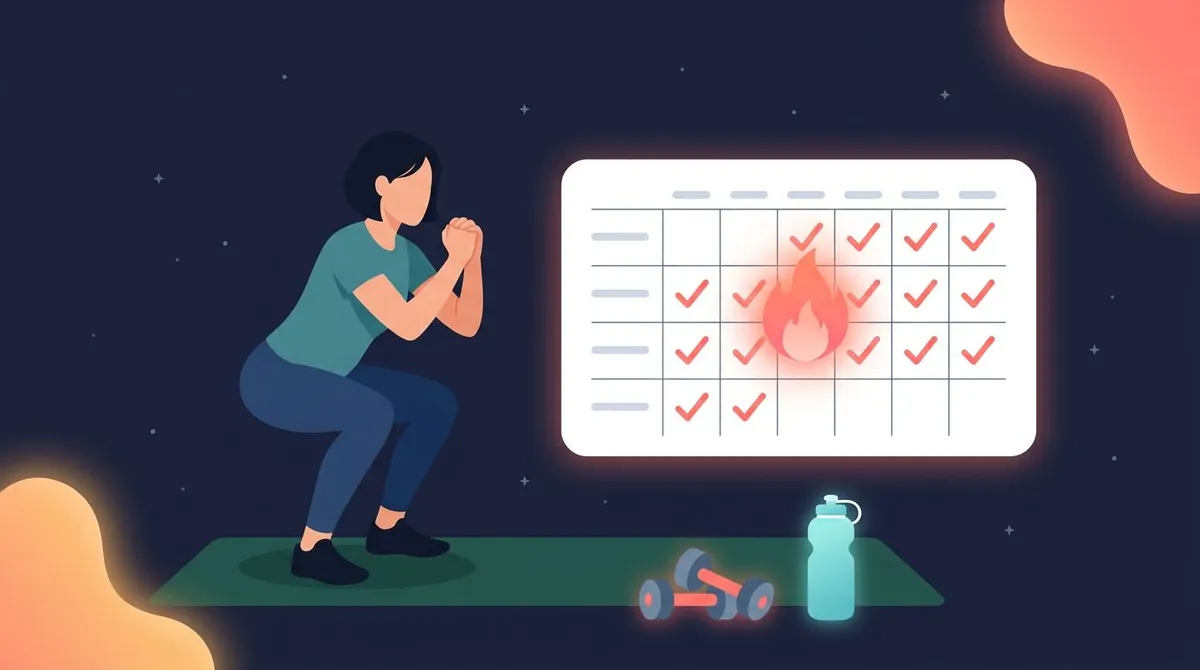
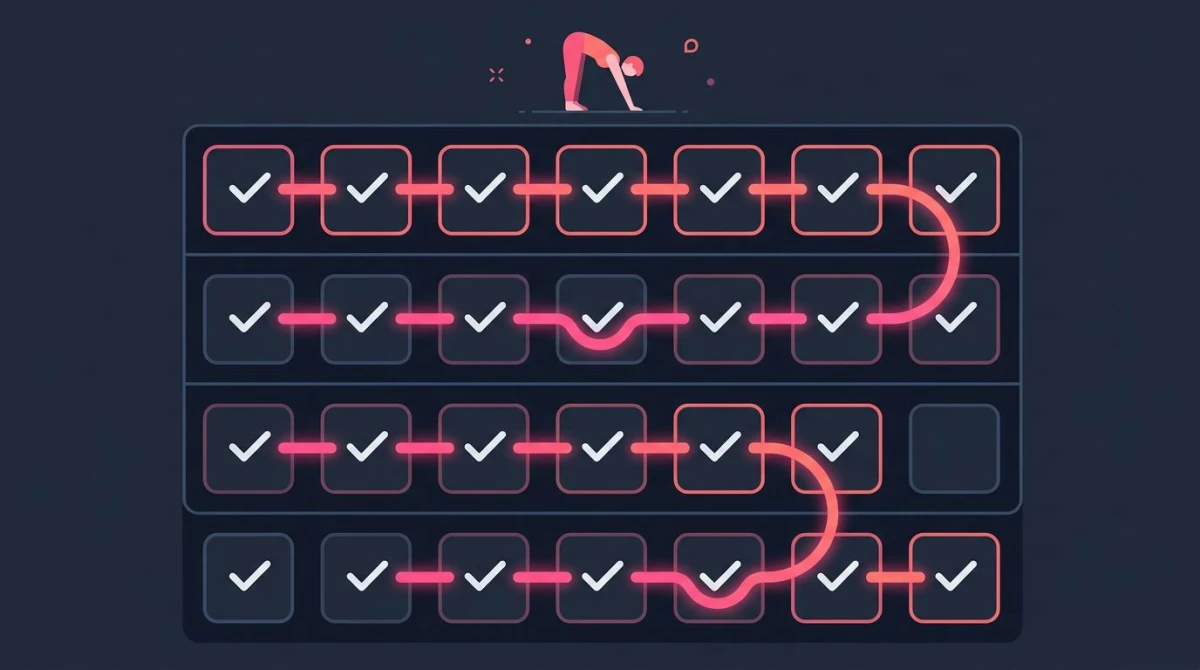
A streak is binary. Did you stretch today, yes or no? Twenty-eight days of yes builds the habit. Twenty-eight days of "I held the hamstring 1 cm deeper than yesterday" is a different game and a worse one for beginners. A simple habit-stacking approach pairs the new behavior with an existing daily anchor, then lets the streak counter do the motivation work.
If you are juggling several habits at once — exercise, hydration, stretching — a dedicated habit tracker lets you see all of them on one calendar heatmap so the visual streak does the work willpower used to do.
5. Decide your "missed day" rule before you miss
Everyone misses a day eventually. Travel, sickness, an emergency, or just life. The habit dies in the interpretation of that miss, not in the miss itself.
Set the rule now, on day one: "If I miss a day, I do not double up. I do not punish myself. I just stretch the next day." Researchers studying habit formation have repeatedly found that one missed day has no measurable effect on long-term habit formation, but how you respond to it does. Two missed days in a row, on the other hand, doubles the chance the habit drops entirely. The rule is simple: never miss twice.
The 4-week beginner stretching plan
This is the plan to follow, day by day, for the first 28 days. It builds slowly so the habit forms before the routine gets hard.
Week 1: Cue first, five stretches
Goal: Lock in the anchor and complete a 6-minute routine every day for 7 days.
Daily routine (5 stretches, 30 sec each):
- Cat-cow flow
- Child's pose
- Doorway chest stretch (each side)
- Standing hamstring (each leg)
- Half-kneeling hip flexor (each leg)
Do not worry about depth. Do not worry about the missing three stretches. The job this week is showing up after your anchor cue, every day. Mark a check in your tracker. Move on.
Week 2: Add the remaining 3 stretches
Goal: Complete the full 8-stretch, 10-minute routine every day for 7 days.
Add these three to your week 1 routine:
- Neck rolls and side bends
- Seated spinal twist (each side)
- Standing calf stretch (each leg)
You should now feel slightly more comfortable in each stretch. Do not push depth. Notice how your body feels different — many beginners report better sleep this week and a small but real change in lower-back stiffness.
Week 3: Hold longer, stay daily
Goal: Complete the full 8 stretches with longer holds (45 sec instead of 30), every day for 7 days.
The stretches are the same. The only change: extend each hold from 30 seconds to 45 seconds. The full routine still fits inside 12 minutes. This is the week your nervous system stops fighting the longer holds, and you start to notice real range-of-motion change in the hamstrings and hip flexors.
Week 4: Make it permanent
Goal: Complete the routine every day for 7 days at your now-natural pace.
By week 4, the cue is doing most of the work. You no longer have to think about whether to stretch. The post-coffee body lowers itself toward the rug. Aim for 7 days of automatic execution.
Once you complete week 4, the routine is no longer a project. It is a habit. From here, the maintenance plan is "keep doing what you are doing" — the same eight stretches, the same anchor, the same 10 minutes. There is no week 5 program. The routine is the program.
If you also have a morning workout routine running, slot the stretches at the end of the workout instead of separately — the muscles are already warm and the cue (finishing the workout) is built in.
When the stretching habit breaks: how to recover
You will miss a day. Probably several. The interesting question is what happens next.
The "never miss twice" rule
The single most important rule for habit recovery is this: never miss the same habit two days in a row. A one-day miss is a blip. A two-day miss is the start of a quit. Behavior science research, including studies on habit formation tracked by Phillippa Lally's team at University College London, consistently shows that the second missed day is the dangerous one. The first miss leaves the habit intact. The second miss starts dismantling the cue association you spent weeks building.
So if you miss Tuesday, the rule is non-negotiable: stretch on Wednesday. Even if it is a 90-second version. Even if you only do child's pose. Anything counts. The point is the cue stayed alive.
What if you miss a whole week?
This happens — vacation, illness, a busy work sprint. Treat it like week 1 again. Go back to five stretches, six minutes, and rebuild the cue for seven days before adding back the full routine. Do not try to "make up" the missed week with a long session on Sunday. That is not how flexibility works, and it is not how habits work either.
You may be tempted to feel guilty and skip the rebuild week. Skip the guilt instead. The body forgets stretching slowly — most of the range of motion you built will still be there. The habit forgets faster. Rebuild the habit; the body follows.
The Sunday reset
If you find yourself missing days regularly, set a weekly reset on Sunday. Look at the past seven days. Did you hit at least 5 of 7? That is a win — keep going. Did you hit fewer than 4? Something is wrong with the cue. Maybe the anchor you picked is not actually as automatic as you thought. Maybe friction is sneaking back in (yoga mat in the closet, stretching room cold, no time after the new anchor).
Diagnose the cue, not your willpower. The same logic applies to any fitness consistency problem — when the habit drops, the cue is almost always the culprit, not motivation.
Common beginner mistakes
A few traps catch most beginners in the first month.
Trying to "feel the burn." Stretching should feel like a 4 or 5 out of 10 pull, never sharp. If it hurts, back off. The protective contraction we talked about earlier kicks in if you push too hard, and you will end up tighter, not looser. Beginners often interpret tightness as a target to overpower, but the muscle reads aggression as danger and clamps down. The release happens when you stop forcing it and breathe instead.
Bouncing. Old gym-class memories say to bounce into a stretch. They are wrong. Bouncing (ballistic stretching) triggers the muscle to fight back. Hold the position. Breathe. Let it release. Modern flexibility research has consistently moved away from ballistic stretching for beginners — it produces small gains at the cost of a much higher injury rate, and the gains do not stick.
Skipping the cue and doing it "later." "Later" never comes. The cue is the routine. If you skip the anchor, you are not stretching today — you are hoping to stretch today. The phrase "I will stretch later" is one of the strongest predictors that the routine is about to die. Every successful habit researcher from BJ Fogg to James Clear arrives at the same conclusion: the cue is the habit. Without the cue, there is no habit, only intention.
Comparing your depth to a yoga influencer. Beginners on Instagram can hold a stretch deeper than you because they have been doing this for years. That is expected. Your week 4 hamstring hold will not look like theirs. It does not need to. Range-of-motion gain is personal — you compete with your week-1 self, not with a stranger. Take a phone video of yourself doing each stretch on day 1, then again on day 28. The progress is almost always there, even when daily measurements feel flat.
Stretching cold without any movement. Even in a gentle routine, doing a hard hamstring stretch as the very first thing out of bed is a bad idea. Always start with cat-cow. The slow spinal flow warms enough tissue to make the rest safe. The full stretching routine takes ten minutes, and the first 60 seconds of cat-cow is non-negotiable insurance against the pulled-something-on-day-3 scenario that ends a lot of routines.
Holding your breath. This is the most under-discussed beginner mistake. Watch yourself in a deep stretch and you will probably catch yourself holding the breath. The held breath signals "danger" to the nervous system and tightens every muscle in the chain you are trying to release. The fix is simple: count slow exhales. If you are holding for 30 seconds, that should be five or six slow exhales. The exhale is what gives you the extra inch of release.
Stretching only the parts that feel tight. Beginners often skip the chest stretch because they don't feel chest tightness — but most desk workers have shortened pecs and do not realize it because the body has adapted. The seated spinal twist gets skipped for the same reason. The whole-body routine matters because the parts that feel fine are often the ones quietly limiting movement everywhere else.
Stretching routine FAQ
How long should I stretch every day as a beginner?
Ten minutes is the right starting point for daily stretching, with each hold lasting 20 to 30 seconds. Longer is not better in the first month. Daily consistency at a short duration produces more flexibility gain than longer sessions done two or three times a week, especially in the first 4 to 8 weeks. Once the habit is locked in, you can extend to 15 minutes or add a second session if you want.
What is the best time of day to do a beginner stretching routine?
The best time is whenever you can attach it to an existing daily anchor. Morning works if you anchor it to coffee or teeth-brushing. Evening works if you anchor it to your laptop closing or to changing into pajamas. The "right time" is the time you will actually do it consistently, not the time some article online recommends. Morning stretching does have one small advantage: it loosens the spine and hips after a night of stillness, and many people find the day goes better when their lower back is unlocked early.
Should I do static or dynamic stretching as a beginner?
For a daily standalone routine, static stretches are the right choice — hold each position for 20 to 30 seconds and breathe. Use gentle dynamic moves like cat-cow and slow neck rolls only as warm-up at the start. Aggressive dynamic stretching and ballistic bouncing belong in athletic warm-ups before sport, not in a daily mobility habit. The eight stretches in this routine deliberately mix static holds with two slow dynamic moves so you can do the routine cold, with no separate warm-up.
Can I stretch every day or do I need rest days?
You can stretch every day. Unlike strength training, gentle daily stretching does not need recovery days because it is not damaging muscle tissue the way heavy lifting does. The Behm and Chaouachi 2011 review on stretching and performance found no harm from daily flexibility work at moderate intensity. The only caveat: if a specific stretch causes lingering pain or a sharp pull, skip that one stretch (not the whole routine) until the soreness clears.
How do I track my stretching consistency?
The simplest method is a calendar with one box per day — check the box if you stretched, leave it blank if you did not. Streak length is the metric to watch, not minutes. A habit-tracking app does the same job with less effort and a cleaner visual: HabitBox's calendar heatmap shows your streak alongside any other habits you are building, so you can see at a glance whether stretching is on track. The visual streak triggers loss aversion — once you have eight days in a row, you do not want to break the chain — and that is what carries the routine through the unmotivated days.
What if I am not flexible enough to do these stretches?
Every stretch in this routine has a beginner version. If standing hamstring stretch is too deep, sit on the floor with one leg out and reach for the shin instead of the foot. If half-kneeling hip flexor hurts the back knee, put a folded towel under the knee. If child's pose does not reach the floor, prop a pillow under your forehead and let it rest there. The right stretch depth is the one where you feel a 4 or 5 out of 10 pull — never sharp pain. Flexibility builds in the easy version too. Start where you are.
How long until I see results from a beginner stretching routine?
Most beginners notice subjective changes in week 2 — better sleep, less low-back stiffness in the morning, an easier time reaching the seatbelt or the top shelf. Measurable range-of-motion gains usually show up between week 3 and week 4. By week 8 of consistent daily practice, most people see a meaningful change in hamstring length and hip flexor mobility. The catch is that this timeline only holds if you stretch daily. Skipping two or three days a week stretches the timeline out to several months for the same result, because flexibility is highly use-dependent.
Do I need a yoga mat to do this routine?
No. A carpet or rug is fine. A bath towel folded in half works for the kneeling stretches. The mat is helpful for cushioning the back and knees on hard floors, but it is not a prerequisite for starting. Do not let the absence of equipment delay day 1. Many beginners use "I need to buy a mat first" as an unconscious reason to put off starting — recognize the pattern and start anyway. You can always add the mat in week 2 if you want.
Is stretching enough exercise on its own?
No, and this is worth being honest about. Stretching maintains and improves flexibility, but it does not replace cardio or strength training. The CDC's physical activity guidelines recommend at least 150 minutes of moderate aerobic activity and two strength sessions per week for adults. A daily stretching routine sits alongside that — not instead of it. That said, building a stretching habit first is often a smart strategy: it is the lowest-friction way to start moving daily, and many people use the stretching streak as a launchpad for adding exercise consistency later. A natural first strength add-on is a day-by-day plank challenge — core work that slots into the same daily session without equipment.
Build the streak that carries the routine
A stretching routine for beginners works the same way every habit works: a clear cue, a low-friction action, and a streak that gives you something to protect. The eight stretches above are not the secret. The anchor is the secret. The 4-week plan is the secret. The streak counter on day 12, when the novelty is dead and the routine still happens because the coffee maker just beeped, is the secret.
If you are juggling stretching alongside other daily habits — workouts, hydration, reading, sleep — a dedicated habit tracker like HabitBox keeps the streaks visible on one calendar so each habit reinforces the others. Free to download on iOS and Android, no account required, your data stays on your device.
Pick the anchor. Roll out the mat. Do five stretches tomorrow morning, after the coffee. Then do it again the day after. By day 28, the routine will run itself.

Mira Hartwell
Editor, HabitBoxEditor at HabitBox. Writes about habit science and productivity, grounding every post in named research (Lally, Wood, Walker, Huberman) instead of recycled advice. Read full bio →