Supplement Tracker App: 5 Picks for Consistency (2026)
A supplement tracker app turns a pile of bottles into a daily check-in you can actually hit. The right one reminds you at the right moment, logs your stack with one tap, and shows the streak that keeps you going. This guide compares 5 apps from the angle most reviews miss: which one helps you build the habit of taking your supplements.
TL;DR
A supplement tracker app helps because pill-taking is a cue problem, not a memory problem. Behaviors stick when they are tied to a stable cue — your morning coffee, your toothbrush — and reinforced by visible feedback like a streak. The 5 apps are compared on five things that matter: reminder flexibility, streak view, multi-dose support, free tier, and platform. Suppco wins for label scanning. Supp. wins for the simplest reminder loop. Supplements AI wins for stack design. Supplify wins for inventory. HabitBox wins if you want to bundle supplements with your other daily habits.
What is a supplement tracker app?
A supplement tracker app is a phone app that logs the supplements you take, sends reminders, and shows your consistency over time. Most also store your stack — the list of vitamins and minerals you take daily — and some scan labels.
Three things separate a real supplement tracker from a generic to-do list. It handles multi-dose schedules — vitamin D in the morning, magnesium at night, fish oil twice with meals. It tells the difference between a missed dose and a deliberate skip. And it builds a streak view so visible progress feeds the habit.
The category sits between two older app types. Medication reminder apps focus on safety alerts, refills, and adherence reports for clinicians. General habit trackers like HabitBox treat each supplement as a daily check-in alongside your workout or meditation. A dedicated supplement tracker app tries to bridge them.

The science: why a supplement tracker app actually works
The reason a tracker beats willpower is not motivation. It is cue stability.
Wendy Wood, the USC psychologist behind Good Habits, Bad Habits (2019), has spent 30 years showing that roughly 43 percent of daily behavior is repeated in the same context every day. Her work, profiled by the American Psychological Association, found that people who succeed with a new habit are not more disciplined — they have stronger context cues. A bottle of vitamin D next to the coffee maker out-performs an intention to "remember to take it."
The 21-day myth still gets quoted in app marketing, but the actual data point is from a 2009 University College London study by Phillippa Lally and colleagues. Lally's team tracked 96 people building a new daily habit and found a median of 66 days before it felt automatic, with a range from 18 to 254 days. Plan for two months of conscious effort, not three weeks.
James Clear, in Atomic Habits, calls the technique "habit stacking" — wedging a new behavior between two existing ones. "After I pour my morning coffee, I will take my D3 and magnesium" works because the coffee is already a fixed cue. Clear's habit stacking guide is one of the cleanest explanations of the idea.
BJ Fogg's Tiny Habits method comes at the same point from another angle. Fogg, who founded the Behavior Design Lab at Stanford, tells people to start absurdly small and to celebrate the action briefly the moment it happens. The "brief celebration" is what app designers turn into a streak counter or a green checkmark — the visual feedback is doing the same work as a tiny self-congratulation.
For a longer walkthrough of how to design the cue itself, this conversation between James Clear and Andrew Huberman is the cleanest 20-minute primer on the mechanic that makes supplement-stacking actually stick:
5 supplement tracker apps compared
The table below covers the features that predict whether you will still be using the app in 30 days.
| App | Platform | Reminder flexibility | Streak view | Multi-dose / day | Free tier |
|---|---|---|---|---|---|
| Suppco | iOS | Per-supplement times | Yes (light) | Yes | Limited |
| Supplements AI | iOS | Stack-level + per-item | Yes | Yes | Yes (ad-light) |
| Supp. | Android | Smart per-supplement | Yes | Yes | Yes |
| Supplify | iOS | Per-supplement + refill | Inventory-based | Yes | Limited |
| HabitBox (general) | iOS, Android | Per-habit, per-day | Calendar heatmap | Yes (count-based) | Free to start (Plus for more) |
Pick in 30 seconds
If you don't want to read the five reviews below, here is the short version:
- You scan new bottles often → Suppco (iOS only)
- You take 8+ items and timing matters → Supplements AI (iOS)
- You're on Android and want the simplest possible app → Supp.
- You keep running out before you reorder → Supplify (iOS)
- Supplements are one habit in a bigger system → HabitBox (iOS + Android)
The reviews below cover the trade-offs in detail.
1. Suppco — best for label scanners
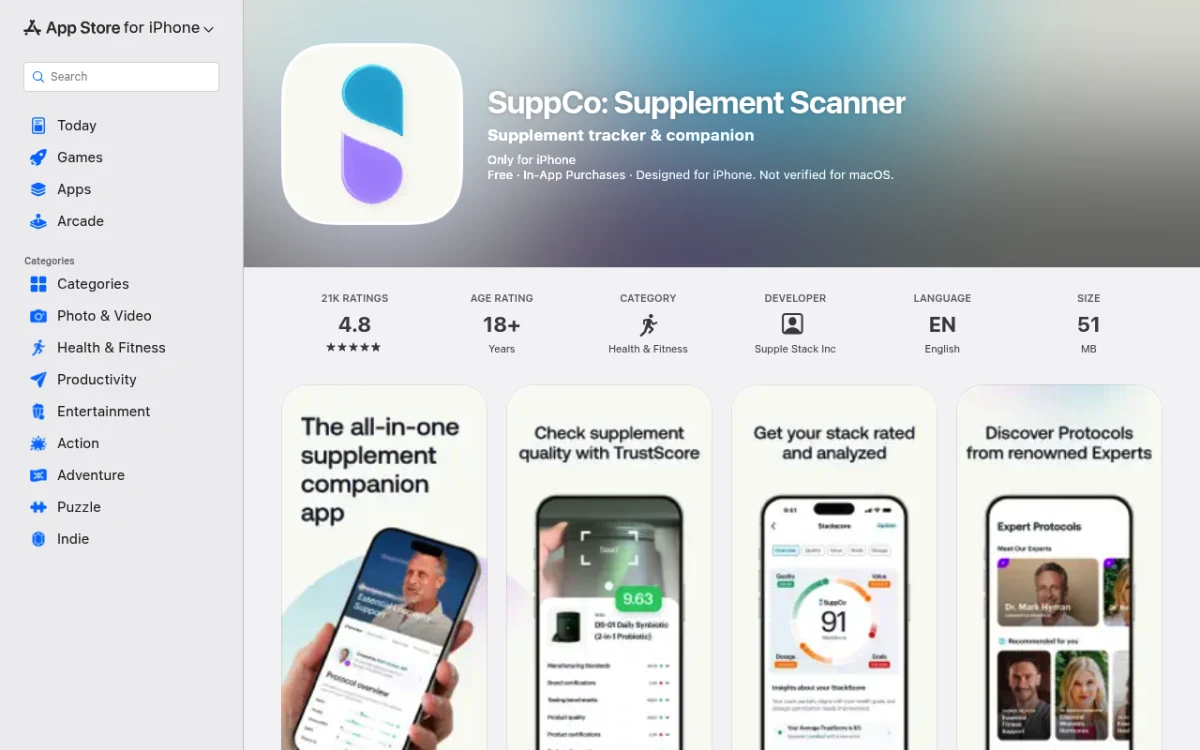
Suppco is the app to pick if your stack changes every few months and you want to scan new bottles instead of typing labels. The scanner reads the supplement facts panel and pulls in serving size, ingredients, and dosage. You can build a profile, set per-supplement reminders, and log doses with a tap.
The streak feedback is light compared to a dedicated habit app — Suppco shows you what you took today and a basic week view, not a long heatmap. Scan and database features are paywalled past a small free quota.
Rating: (4/5)
Pick Suppco on iOS if you swap supplements often. Skip it if you are on Android or want a strong streak view.
2. Supplements AI — best for stack design
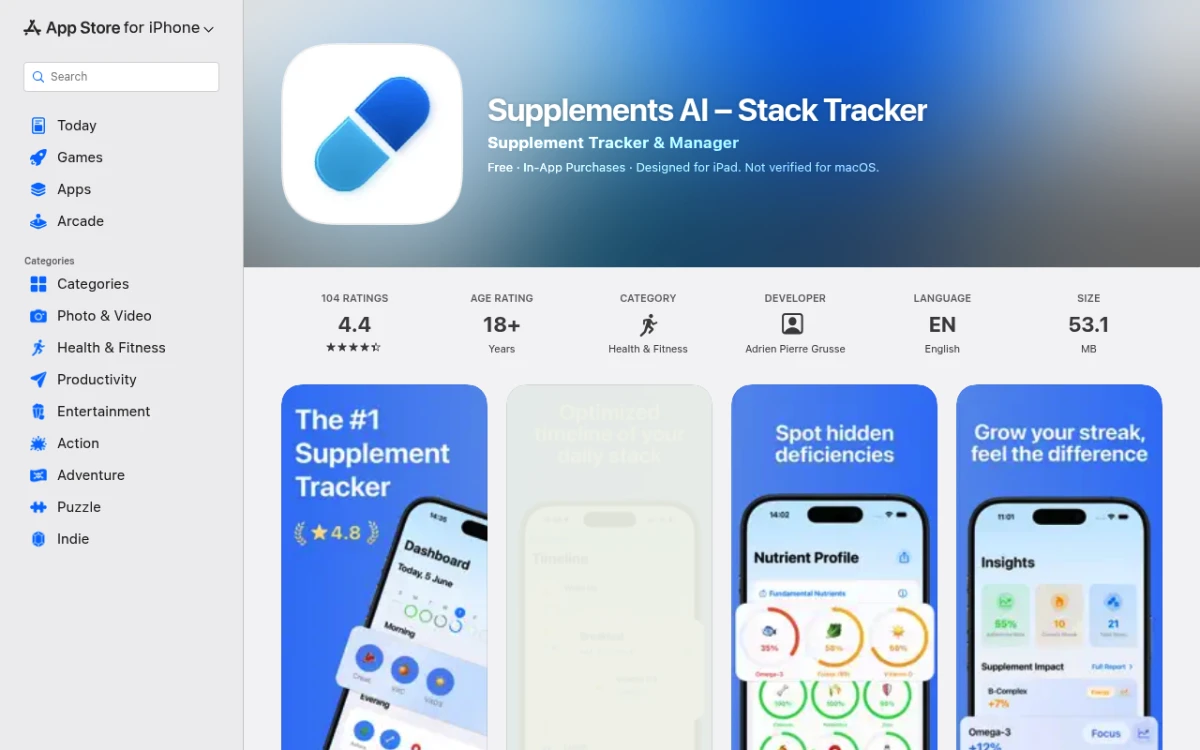
Supplements AI leans into the "stack" framing — the curated list of products you take together, with timing logic for what goes with food and what doesn't. The AI features suggest interactions and time-of-day groupings, useful if you take eight or more items and timing matters (zinc and copper, calcium and iron, magnesium at night).
Reminders work at both the stack level (one notification for the morning bundle) and the per-item level. The free tier is generous enough that most casual users won't need to upgrade.
Rating: (4/5)
Pick Supplements AI for a complex daily stack with timing logic. Skip it if you only take two or three things.
3. Supp. — best for the simplest reminder loop
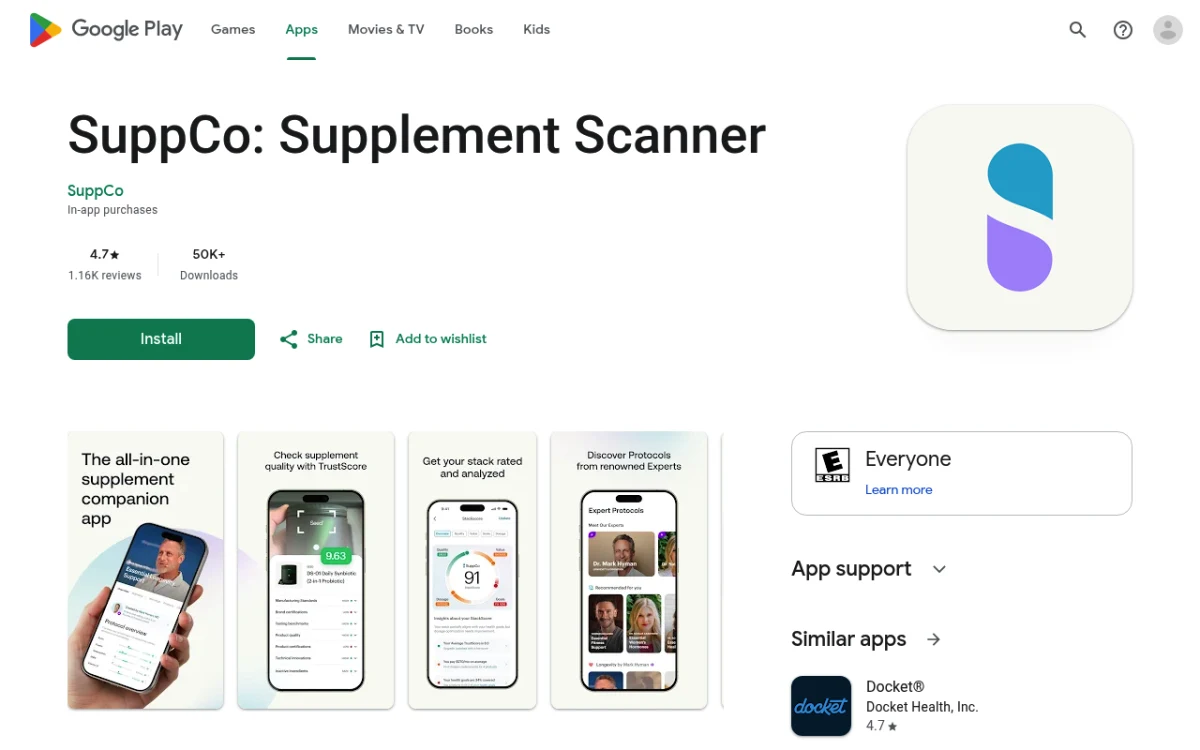
Supp. on Google Play is the cleanest "open the app, tap, done" experience for Android users. It does one job: remind you, log the dose, show the streak. No social features, no AI, no scanner — just a per-supplement reminder schedule and a clear daily view.
The free tier is the strongest of the dedicated apps reviewed here. The streak view is straightforward: a calendar of green and gray, no gamification gloss. For habit-formation purposes, that simplicity is a feature.
Rating: (4.5/5)
Pick Supp. on Android for 2 to 6 supplements with minimum app friction. Skip it if you need iOS-only widgets or label scanning.
4. Supplify — best for inventory and refills
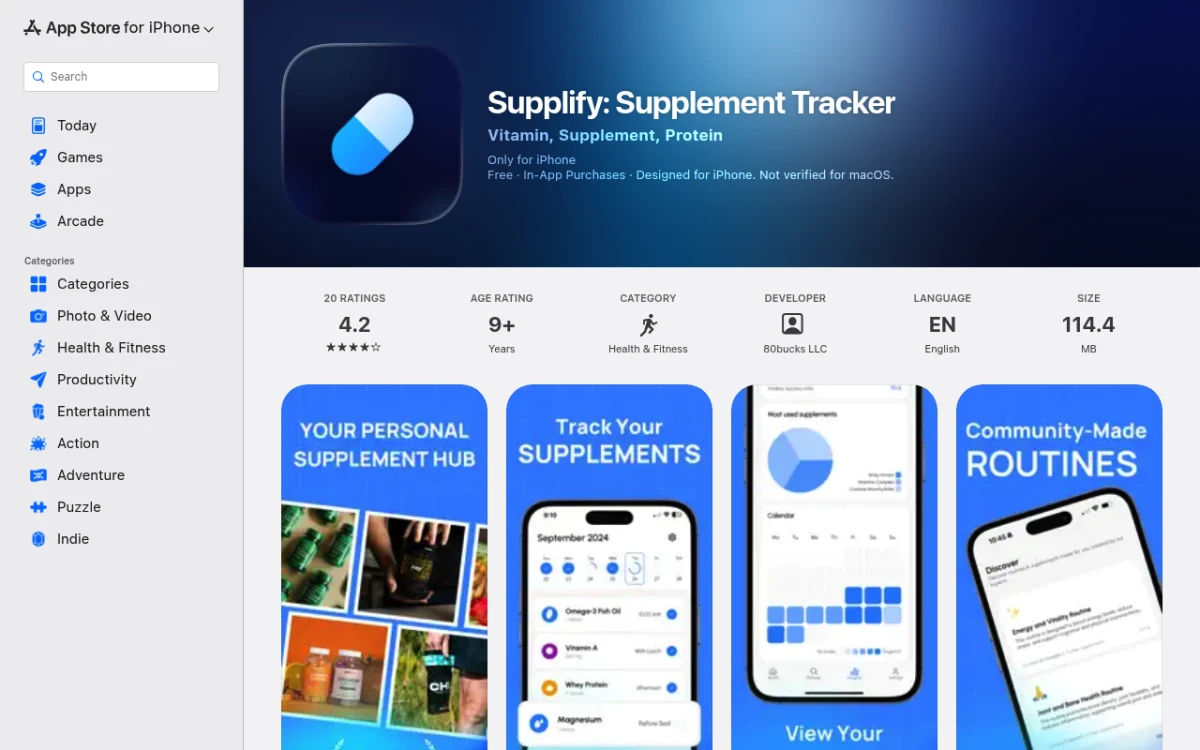
Supplify blends a daily tracker with an inventory manager. It estimates when each bottle will run out and reminds you to reorder before you skip a day because you ran out. For people who buy from three brands and lose track, this is genuinely useful.
Per-supplement reminders are flexible, and you can set start and end dates for time-limited courses (a four-week iron protocol, for example). The streak view is tied to inventory rather than a pure consistency calendar.
Rating: (4/5)
Pick Supplify on iOS if running out is your main consistency problem. Skip it if you only take one or two long-term items you re-buy on autopilot.
5. HabitBox — best for bundling supplements with other habits
HabitBox is not a dedicated supplement tracker. It is a general habit tracker that handles supplements as well as any specialist app, and the wedge is honesty: if "take supplements" is one of seven habits you want to build, opening seven apps is the friction that ends the experiment in two weeks.
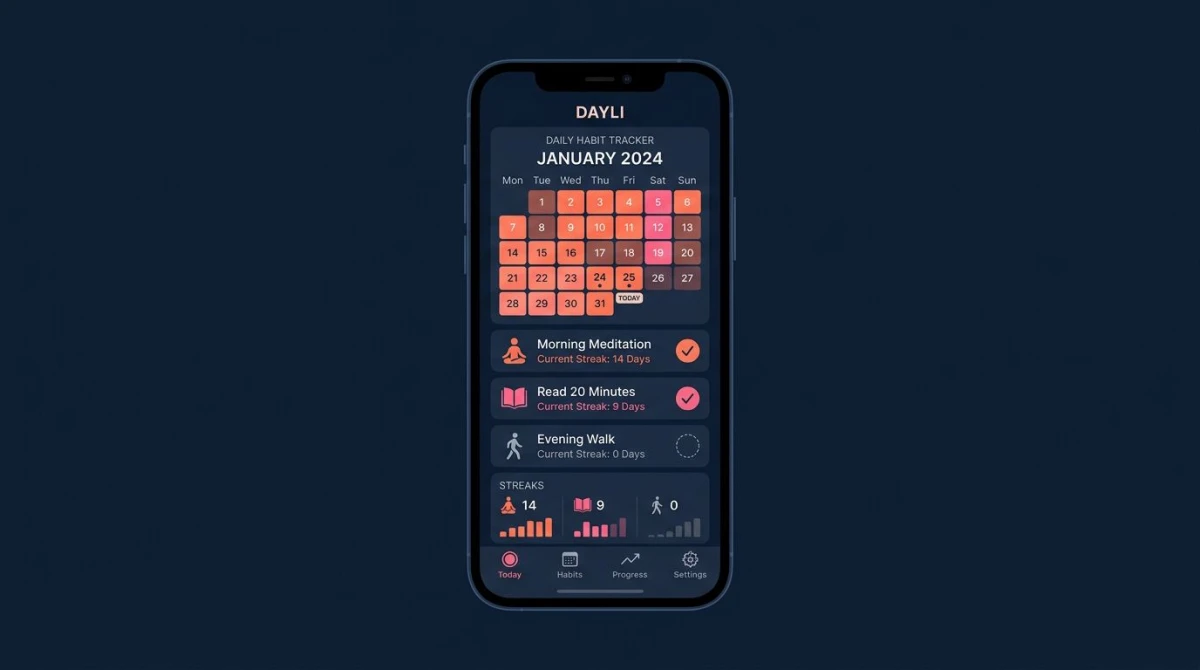
In HabitBox, each supplement (or grouped stack) becomes a daily habit with reminders, multi-dose support via count-based habits, a streak count, and a calendar heatmap that shows your consistency for that habit. You see your supplements next to your workouts and your reading. It is iOS and Android, free to start with an optional Plus upgrade. There is no label scanner and no interaction database — if you need either, pick Suppco or Supplements AI.
Rating: (4.5/5)
Pick HabitBox if supplements are part of a broader habit system. Skip it if you specifically want a tool that scans bottles or models drug interactions.
There is also SuppTrack — a newer web-first option worth a look if you prefer a browser tab over a phone app.
How to actually build the supplement habit
Picking the app is the easy part. Building the habit is where most people stall in week two.
- Anchor your dose to a stable existing cue, not a clock time. "After I pour my morning coffee, I take vitamin D" beats a 7 a.m. reminder. The coffee is already happening. The reminder competes with everything else on your phone.
- Move the bottles to where the cue lives. If the anchor is your coffee, the bottles go on the coffee station. If it is brushing your teeth, they go in a tray next to the toothbrush. The behavior science term is friction reduction — Wood's research shows it is one of the highest-leverage habit changes available.
- Start with one or two supplements, not your full stack. Adding eight new behaviors at once is how the experiment fails. Get D3 to 14 days of consistency before adding magnesium. BJ Fogg's Tiny Habits method is built around this point.
- Set the reminder for after the cue, not as a backup alarm. A good reminder fires when the action would happen anyway. If you take supplements with breakfast, set it for 10 minutes after you usually start eating, not 7 a.m. sharp.
- Use the streak as feedback, not pressure. A long streak is a record of past consistency, not a contract. Treat the goal as "miss less than once a week" rather than "never miss."
- Plan for the second-day rule. Missing one day is a slip. Missing two in a row is the start of a new (worse) habit. Never skip twice.
For a deeper walkthrough on locking in any new daily behavior, our guide on habit formation covers the cue-routine-reward loop in more detail, and tracking habits shows what to do with the data after a few weeks.
A 30-day starter plan
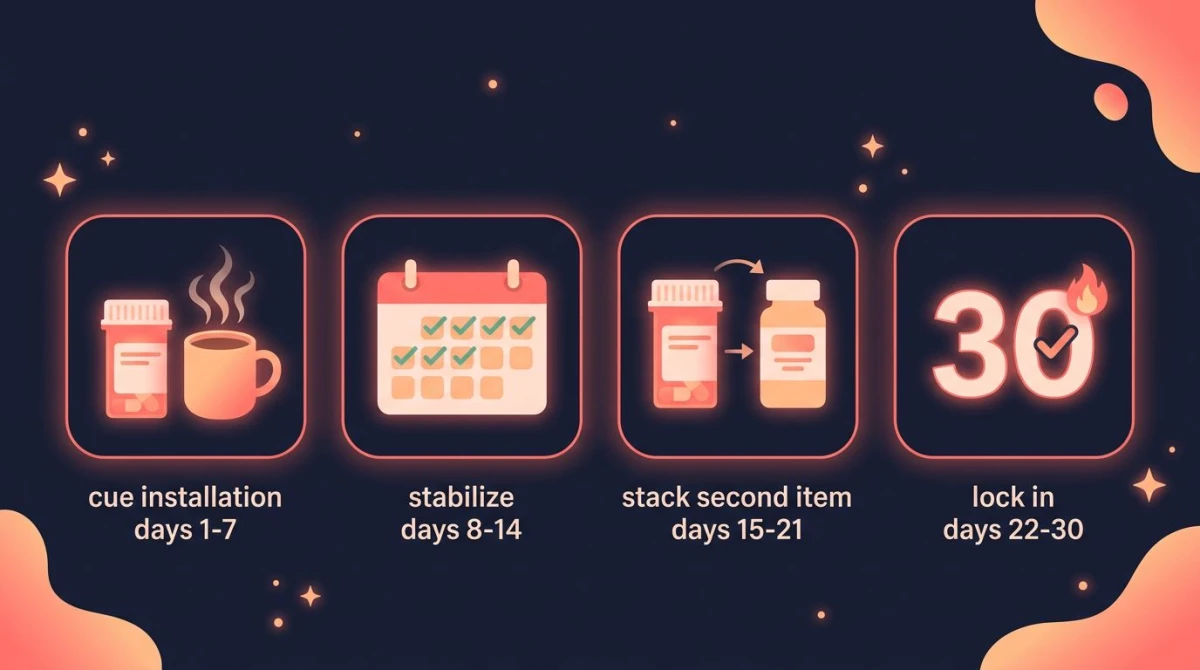
Here is a track-it ramp that works whether your stack has 2 items or 8. The point is not the supplements themselves — it is the cue and the visible streak.
Days 1 to 7: install the cue. Pick one anchor (coffee, breakfast, brushing teeth) and one supplement to attach to it. Move the bottle to where the anchor happens. Set a per-supplement reminder for 5 minutes after your anchor. Goal: 7 of 7 days.
Days 8 to 14: stabilize. Same supplement, same cue. The honest week — this is when reminders get dismissed and you find out whether the cue is strong on its own. If you missed two days, the cue is wrong. Move the bottle to a different anchor and restart.
Days 15 to 21: add a second item or a second daily dose. Only after one supplement has hit a 14-day streak. Stack the new item to the same cue if it shares timing, or build a second cue for an evening dose. Track each separately so the streak data stays clean.
Days 22 to 30: add a third item or stop. By day 30 the original supplement should feel automatic. If a third item feels heavy, you have your answer — your sustainable stack is two, not five.
By day 30 you should know two things: which cue actually works in your day, and which supplements you will keep taking after you stop tracking.
Which supplements are actually worth tracking?
This isn't medical advice, but a tracker is only as useful as the stack behind it. A short, honest take on the items most people put in their tracker:
| Supplement | Evidence quality | When tracking it matters most |
|---|---|---|
| Vitamin D3 | Strong — widespread deficiency, especially in winter and at higher latitudes (NIH) | Most people; check a blood level first if you can |
| Magnesium (glycinate or citrate) | Moderate — sleep, muscle relaxation | If sleep or cramps are a pain point |
| Omega-3 (EPA/DHA fish oil) | Moderate — cardiovascular, mood | If you eat fish less than twice a week |
| Creatine monohydrate | Strong (for muscle + cognition) | If you train resistance or want a cognition bump |
| B12 | Strong for vegans/vegetarians, older adults | Plant-based diet or 60+ |
| Multivitamin | Mixed — convenient floor, not a cure | "Insurance" if your diet is irregular |
| Greens powder | Weak — marketing-heavy category | Skip unless you genuinely don't eat vegetables |
| Mushroom blends, "nootropics", super-stacks | Mostly weak | Track these last; cut them first if your stack is overwhelming |
For neutral, plain-language detail on any of these, the NIH Office of Dietary Supplements factsheets cover what the evidence actually says. A 4-item stack you take every day beats a 12-item stack you take 60 percent of the time.
When the habit breaks: the missed-day rule
Every tracker eventually shows a gap. The wrong move is to feel guilty and quit. A 23-day streak with a one-day miss is functionally the same as a 30-day streak — your brain has learned the cue, your bottles are in the right place, your tracker is set up.
The right move is the second-day rule. You can miss once and recover. Missing twice in a row is when the new (worse) habit installs itself. The priority on the day after a miss is today's dose at today's cue — not catching up, not doubling up (which can be unsafe for some products).
If you miss more than once a week consistently, three things are usually wrong. The cue is unstable (you skip breakfast some days). The supplement is too far from the cue (bottle in the cabinet, not on the counter). Or the dose itself is not yet worth the friction. Fix one variable at a time.
The NIH Office of Dietary Supplements is worth a read on whether each item in your stack is doing what you think. The NIH National Center for Complementary and Integrative Health has plain-language overviews. None of this is medical advice — for anything beyond a daily multivitamin, talking to a clinician beats a forum thread.
Frequently asked questions
What is the best free supplement tracker app?
What's the difference between a pill reminder app and a habit tracker?
How do I remember to take my supplements every day?
Can I use a supplement tracker for multiple doses per day?
Are supplement tracker apps safe for prescription medications?
How long until taking supplements feels automatic?
Bottom line
A supplement tracker app is a cue and a streak, dressed up with extra features. The dedicated apps — Suppco, Supplements AI, Supp., Supplify — each win on a specific axis: scanning, stack design, simplicity, inventory. If supplements are the only daily habit you are building, any of them will work.
If supplements are one habit on a longer list, a general habit tracker like HabitBox handles the same job — reminders, multi-dose logging, streak views, calendar heatmap — and shows your supplements next to your workouts, your reading, and your sleep window. For a wider comparison of what makes a habit app actually stick, the guide on the best habit tracker app walks through the trade-offs.
Whatever you pick, the cue matters more than the app. Move the bottles. Tie the dose to coffee or teeth. Let the streak do the rest.

Mira Hartwell
Editor, HabitBoxEditor at HabitBox. Writes about habit science and productivity, grounding every post in named research (Lally, Wood, Walker, Huberman) instead of recycled advice. Read full bio →