30-Day Gratitude Challenge: Prompts + Tracker (2026)
Most 30 day gratitude challenge plans fail the same way: a list of generic prompts, a cute printable, and no plan for what happens on day 31. This guide gives you a fresh prompt for each of the 30 days, a track-the-streak setup that turns the challenge into a real habit, and a graduation plan that converts the month into a permanent three-minute daily practice.
TL;DR — the 30-second answer
A 30 day gratitude challenge measurably improves wellbeing within two to three weeks — but only if you graduate it into a permanent three-minute daily habit afterward. The original randomized trial by Emmons and McCullough (2003) showed higher life satisfaction and optimism in the gratitude group versus controls. The catch: most challenge participants stop on day 30 and lose the gains. Pair the 30 daily prompts in this guide with a habit tracker that records the streak, then keep one prompt per day going past day 30. That is the difference between a wellness moment and a wellness habit.
What is a 30 day gratitude challenge?
A 30 day gratitude challenge is a structured month-long practice in which you respond to a specific gratitude prompt each day — usually a short written entry. The prompt rotates daily so the practice does not collapse into "what are you grateful for?" repeated thirty times. The fixed end date lowers the activation cost of starting; the daily cadence builds the neural groove.
The point is not the thirty days. The point is what those thirty days install — a noticing habit that survives stress, travel, and bad days. Most people treat the challenge as a self-contained event and quit on day 31. This guide is built differently: the challenge is the on-ramp, the habit is the destination.
The science: why a daily gratitude practice actually works
Three lines of research shape how a 30-day challenge should be designed.
Emmons and McCullough's "Counting Blessings" study (2003). Robert Emmons of UC Davis and Michael McCullough of the University of Miami ran one of the most-cited gratitude experiments. Participants were assigned to one of three groups — weekly gratitude lists, weekly hassles, or neutral events. After 10 weeks the gratitude group reported higher life satisfaction, more optimism, fewer physical complaints, and more exercise. The original paper is indexed on PubMed and remains the foundation of the field.
Robert Emmons' broader program at UC Davis. Emmons has spent more than two decades on this. His UC Davis faculty page collects the work — the headline finding is that gratitude works as both a state and a trait, and practice can shift the trait over months, not weeks. That trait shift is what you are training during a 30-day challenge.
The Greater Good Science Center at UC Berkeley. GGSC, directed by Dacher Keltner, translates the field for the public. Their gratitude topic hub and Gratitude white paper pull the research into three recommendations: consistency over intensity, vary the prompts to defeat habituation, and pair gratitude with concrete behaviors rather than just thinking it.
Habit-formation research from UCL. Phillippa Lally and colleagues found that automaticity took a median of 66 days — far past the 21-day myth. A single missed day did not measurably slow the curve. Translation: a 30-day challenge will not finish the habit-formation job. It gets you to roughly the halfway mark. Plan for that.
The honest summary: gratitude practice is one of the better-evidenced lifestyle interventions for everyday wellbeing, and 30 days is enough to install the noticing reflex. It is not a treatment for clinical depression and is not a substitute for professional care.
How the 30 days are structured
Thirty unique prompts are not enough on their own — the same prompt-shape every day turns into autopilot scribbling by week two. The fix is to rotate themes by week, so each phase pulls your attention somewhere new.
| Week | Theme | What it trains | Sample prompts |
|---|---|---|---|
| Week 1 (Days 1-7) | Foundation — easy wins | Notice the obvious good things | People, comforts, simple pleasures |
| Week 2 (Days 8-14) | People & relationships | Specific named gratitude | Family, friends, mentors, strangers |
| Week 3 (Days 15-21) | Reframe & resilience | Find growth in difficulty | Hard moments, lessons, "in spite of" |
| Week 4 (Days 22-28) | Self & senses | Present-moment noticing | Body, taste, sight, sound |
| Days 29-30 | Forward-facing | Anticipatory gratitude | The future, the streak itself |
Each week's prompts get more specific than the last — by week three you are reframing hard moments, which is harder than listing comforts. The Greater Good Science Center recommends prompt variation for exactly this reason: writing the same shape of gratitude repeatedly drains the practice of effect.

The 30 daily gratitude prompts
One prompt per day. Three to five sentences is plenty. You can write in a paper journal, a notes app, or speak the entries out loud — the medium matters less than the consistency. (If you do want a dedicated app, our companion piece on the best gratitude journal app compares six picks.)
| Day | Theme | Prompt |
|---|---|---|
| 1 | Foundation | Three small things that went well today, and one sentence on why each one mattered. |
| 2 | Foundation | A comfort in your home you take for granted. Why is it there, and who is responsible? |
| 3 | Foundation | A piece of food or drink you genuinely enjoyed today. Describe the taste, not the calories. |
| 4 | Foundation | A song, book, or show that lifted your mood this week. What part stuck with you? |
| 5 | Foundation | Something your body let you do today without complaint — walking, sitting, breathing. |
| 6 | Foundation | A piece of weather, a view, or a moment outside that you noticed. |
| 7 | Foundation | One ordinary object you use daily that you would miss if it disappeared tomorrow. |
| 8 | People | Someone who made your day easier this week. Name them, name what they did. |
| 9 | People | A person from your past — alive or not — whose influence still shapes how you act. |
| 10 | People | Someone who is hard for you to be grateful for, and one specific thing they have given you. |
| 11 | People | A stranger whose small kindness landed (a barista, driver, neighbor). What did they do? |
| 12 | People | A friend you have not contacted recently. Write what you appreciate about them — then send some of it. |
| 13 | People | A teacher, coach, mentor, or boss who changed how you think. What did they teach you? |
| 14 | People | A family member you sometimes clash with. Name one thing they do right. |
| 15 | Reframe | A recent setback. What did it protect you from, or teach you, that the easier path would not have? |
| 16 | Reframe | Something you used to want and no longer do. What replaced it, and was the trade good? |
| 17 | Reframe | A version of yourself from five years ago who would be impressed by where you are now. What would they notice? |
| 18 | Reframe | A loss or ending that made room for something present in your life today. |
| 19 | Reframe | A criticism you received that turned out to be useful. What did it change? |
| 20 | Reframe | A boring routine in your life that quietly works. Why are you grateful it is boring? |
| 21 | Reframe | A "no" you said or received that improved your life. What did it free up? |
| 22 | Senses | A sound from today — music, a voice, a city, a quiet — that landed well. |
| 23 | Senses | A smell from this week that pulled you somewhere. Where did it take you? |
| 24 | Senses | A texture, a fabric, a temperature your body enjoyed today. |
| 25 | Senses | A view from a window — yours or someone else's — that you noticed. |
| 26 | Senses | A part of your body you tend to criticize. Write one specific thing it has done well for you this month. |
| 27 | Senses | A flavor pairing or meal you ate today. Why did it work? |
| 28 | Senses | A movement your body made easily today — a stretch, a walk, a stair, a hug. |
| 29 | Forward | One thing you are looking forward to in the next month. Sit with the anticipation, not the planning. |
| 30 | Streak | The 30 days themselves. What changed in your noticing? What surprised you? |
Print this table, screenshot it, or paste it into your notes app. The prompt for the day is your only assignment. Three to five sentences. Same time each day.
How to actually build the habit (cue, friction, streak)
The prompts are the content. The mechanics below are what carry you to day 30 and beyond.
1. Pick one cue, not a clock alarm. Habits attach to context, not time. Wendy Wood's USC work found that roughly 43% of daily behavior is repeated in the same context. Pick a moment that already happens every day — morning coffee, the commute home, the minute after you brush your teeth. The cue does the remembering. We unpack the technique in our habit stacking guide.
2. Cut the friction to under 30 seconds. The single biggest reason daily practices die is friction. If you have to find a notebook, find a pen, find the prompt, the practice will lose to your phone by day 11. Set the prompt source up the night before — a phone Note, a printed sheet on the nightstand, a saved bookmark on your home screen.
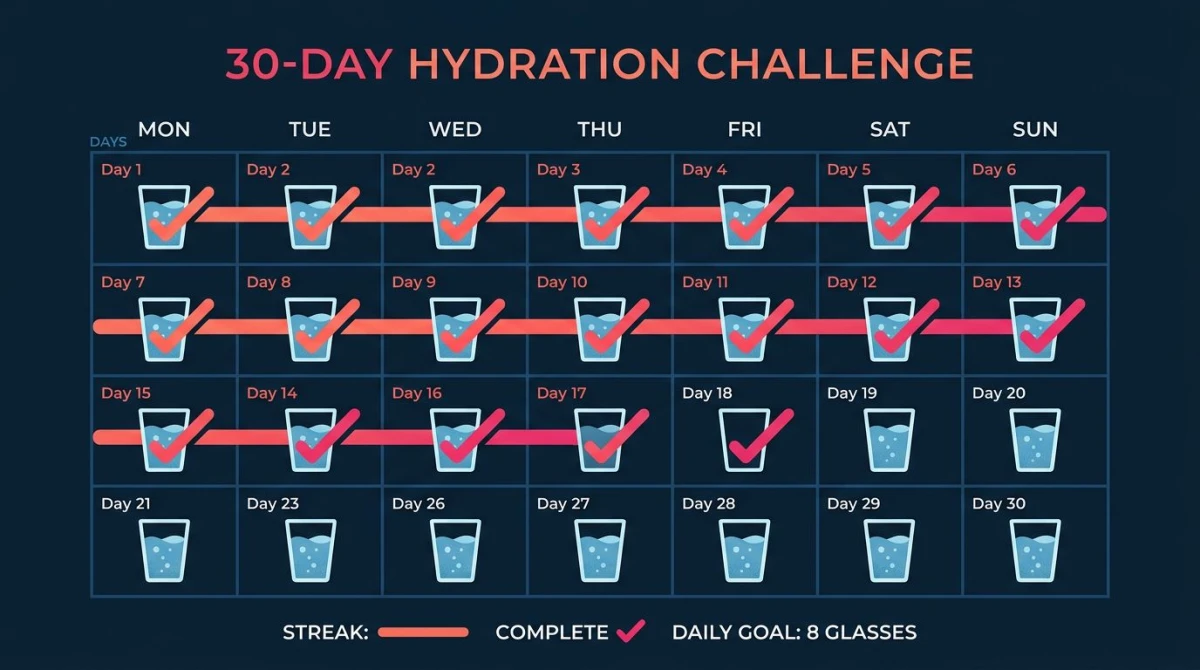
3. Track the streak in one place. Three reasonable options:
- Paper grid — a printed 30-square calendar. Simple, dies if you travel.
- Notes app checkboxes — fast, easy to forget when it lives next to your grocery list.
- Dedicated habit tracker — built for daily check-ins and streak visualization, isolated from the noise.
A focused habit tracker like HabitBox is built for the streak side of the challenge, not for storing the writing — you keep the prompt in your journal of choice and tap a single check-in to log "did the prompt today." The streak counter and calendar heatmap surface the chain at a glance, which is what carries you past day 11 when novelty wears off. (Our best gratitude journal app piece compares dedicated writing apps if that side is where you want help.)
4. Plan for misses, in advance. The Lally UCL study found a single skipped day did not measurably slow habit formation; what hurt was missing many days in a row. The rule, from James Clear, is "never miss twice." If you skip day 12, day 13 is non-negotiable. Do not double up. Do not restart the count. Our tracking habits guide goes deeper on streak recovery.
5. Match the medium to your style. The Greater Good Science Center notes that telling someone (a gratitude letter, a thank-you message, a verbal acknowledgment) is associated with larger and longer-lasting wellbeing effects than private writing alone. If writing feels like a chore, speak the prompt as a voice note or tuck a "people" prompt into a real conversation. For people brand-new to writing daily, our how to start journaling walkthrough covers paper vs. app and blank-page paralysis.
A 7-day starter ramp (if 30 feels like too much)
Thirty days is the goal, but not the entry point. If you have failed at gratitude challenges before, ramp the first week so the floor is impossibly low.
- Day 1. Read prompt 1. Write one sentence. Tap the tracker.
- Day 2. Prompt 2. Two sentences. Tap.
- Day 3. Prompt 3. Three sentences. Tap.
- Days 4-6. Same as day 3 — three sentences, same time, same place.
- Day 7. Review. Did the cue work? Move it earlier or later if not.
By day 7 you have a working cue and seven entries in the tracker. From day 8, follow the prompt schedule above. The first week's only job is to lock the cue.

When it doesn't work — and how to recover
A few honest patterns show up around days 9 to 14, and again around day 22.
The "this feels fake" wall (around day 9-12). The first week is easy because everything is novel. By day 10 the prompts can start to feel performative. The fix is prompt rotation — week 2 shifts to specific named people, which is harder to write generically. If you still hit the wall, swap to spoken gratitude for two days.
The midpoint slump (around day 14-17). The early excitement is gone and the finish line is still far away. The streak counter is what carries you through — when the only motivation left is "do not break the chain," loss aversion does the heavy lifting. The reframe prompts in week 3 help too. Gratitude for difficulty is harder than gratitude for comfort, but it is also more durable.
The "I missed three days" recovery. If you miss three or more days, do not restart the count. Restarting is the trap that turns a 30-day challenge into an endless first week. Pick up where you left off — if you missed days 14-16, day 17's prompt is your next entry. The streak resets, but the practice does not.
A note on mental health. This is a lifestyle guide, not medical advice. Gratitude practice is well-evidenced for everyday wellbeing, but it is not a treatment for clinical depression, generalized anxiety, or PTSD. If your low mood persists for more than two weeks or you are having thoughts of self-harm, contact a clinician. In the US, 988 reaches the Suicide and Crisis Lifeline 24/7. The Harvard Health overview of gratitude research is a good starting primer.
After day 30 — the graduation plan
Day 30 is not the finish line; it is the on-ramp's exit. The UCL data puts automaticity at a median of 66 days, so day 30 is roughly halfway. Stopping on day 31 usually means the practice fades within two to three weeks.
Three options for what comes next:
- The maintenance loop. Keep one prompt a day, drop the weekly themes. Pick the prompt style that worked best (most people gravitate to senses or people) and rotate within it. Five sentences becomes three.
- The weekly version. If daily feels like too much, shift to one Sunday-night long-form entry — fifteen minutes, three to five things. Emmons and McCullough's 2003 study used a weekly cadence and still found significant effects. You lose the streak mechanic but keep the practice.
- The stack. Use the now-locked cue to add a second behavior — a one-minute breathing cycle before the prompt, a stretch after, or a one-line mood log alongside. The gratitude practice becomes the anchor for a small wellness routine.
Whichever route you pick, keep the tracker running 60 more days. By day 90, gratitude is something you do, not something you remember to do.
Frequently asked questions
What is a 30 day gratitude challenge?
How long does it take for a gratitude practice to actually work?
What are the best gratitude challenge prompts?
Can couples or partners do a 30 day gratitude challenge together?
What do I do after the 30 days end?
Is a 30 day gratitude challenge a substitute for therapy?
Putting it into practice
Start today, not Monday. Pick the cue — the moment in your day you will hook this to. Read prompt 1. Write one sentence. Tap the tracker. That is day one done.
If you want a frictionless way to log the streak across all 30 days (and the 60 after), a simple habit tracker like HabitBox gives you one-tap check-ins, a calendar heatmap, and a streak counter — built for the keep-it-going side of the challenge while your journal of choice handles the writing. Whatever you pick, the rule is one tracker, not three. The practice is the prompt; the tool is just the chain.

Mira Hartwell
Editor, HabitBoxEditor at HabitBox. Writes about habit science and productivity, grounding every post in named research (Lally, Wood, Walker, Huberman) instead of recycled advice. Read full bio →