Digital Detox Challenge: 30-Day Plan to Track (2026)
A digital detox challenge is a structured 30-day reset of phone and social media habits — without quitting cold turkey. Most plans fail because they swap one all-or-nothing rule for another. This guide walks you through four weekly milestones — awareness, limits, replacement, maintenance — with a daily habit checklist you can track. By day 30, your phone serves you instead of the other way around.
What is a digital detox challenge?
A digital detox challenge is a defined window — usually 30 days — where you intentionally reduce non-essential screen time and rebuild healthier patterns around your phone. It is not a vow of silence or a vacation from technology. The goal is to swap reflex scrolling for deliberate use, one cue at a time.
Two pieces of research shape the modern version. Hunt et al. (2018, U Penn) capped social apps at ~10 minutes each per day for three weeks and saw measurable drops in loneliness and depression (PubMed: 30362967). Cal Newport's Digital Minimalism (2019) frames it as a 30-day reset followed by a deliberate add-back of only the tools that earn their place (calnewport.com). Short, structured, paired with replacements — that beats willpower alone.
Why a structured digital detox actually works
Phone habits are sticky for a reason. USC behavioral scientist Wendy Wood has shown that roughly 43% of daily behavior is repeated in the same context — same place, trigger, time of day. Behavior follows cues, not intentions. Your phone has wired itself into nearly every cue you have: morning, mealtime, bedtime, boredom.
A detox works when it changes the cues, not just the wish. Three mechanisms do most of the heavy lifting.
Friction. A 2022 review in Computers in Human Behavior Reports found small environmental changes — phone in another room, apps off the home screen, grayscale — reduce use more reliably than self-talk (PMC9047823). The brain takes the easy path. Make the path harder.
Replacement. Pulling the phone away leaves a vacuum. If nothing fills it, the old habit returns within days. James Clear's habit-stacking formula — after current habit], I will [new habit] — gives freed-up moments a new behavior ([jamesclear.com/habit-stacking).
Streaks. Phillippa Lally's 2010 UCL study found new habits became automatic after a median of 66 days, with consistent context as the strongest predictor of success (Lally et al., 2010). Thirty days won't fully cement a pattern, but it gets you past the hardest stretch — the first two weeks, when the old cue pulls hardest.
The APA has also flagged constant social media checking as linked to worse sleep, attention, and mood (APA, 2023). The challenge isn't anti-phone. It's pro-attention.
A note on mental health: phone overuse can amplify anxiety and low mood, but it isn't the same as a clinical condition. A 30-day detox is a habit experiment, not a treatment. If symptoms persist or get worse, talk to a licensed professional. The NHS Every Mind Matters and NIMH sites are good starting points.
If you want a first-person view of what a real 30-day detox actually feels like — the temptations, what worked, what didn't — this honest walkthrough is a good warm-up before you start your own:
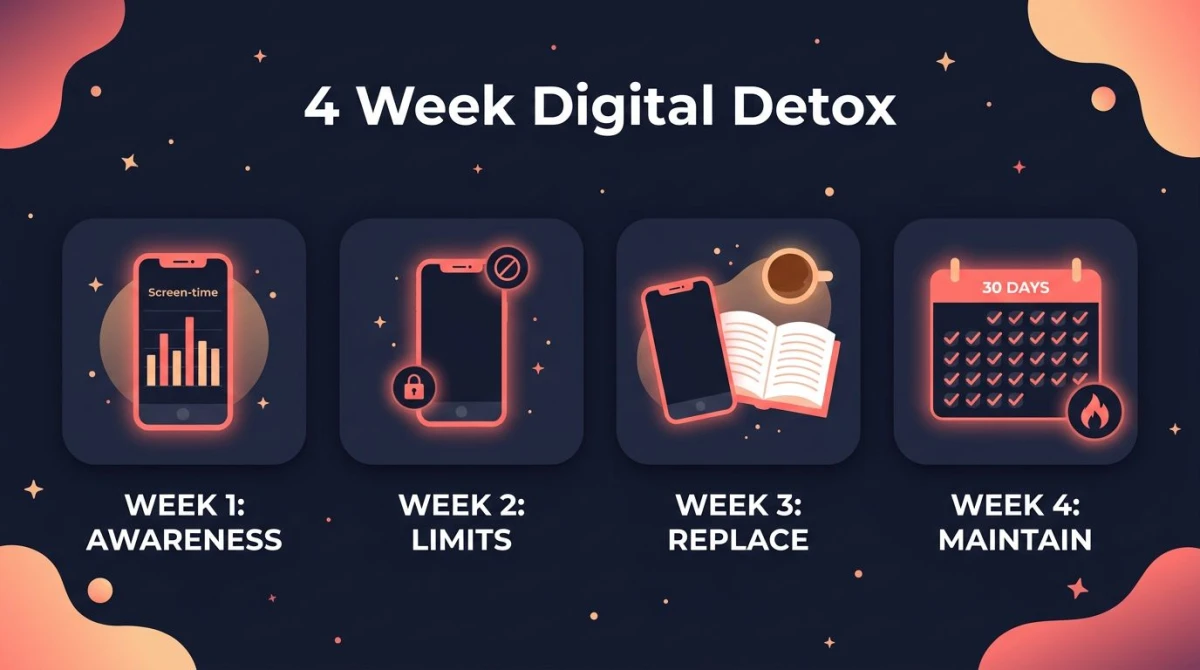
The four-week digital detox plan at a glance
Each week has one job. You don't try to fix everything at once.
| Week | Days | Focus | Daily check-ins |
|---|---|---|---|
| 1 — Awareness | 1–7 | Track without changing | Log screen time, mood at 9 p.m. |
| 2 — Limits | 8–14 | Set boundaries that bite | Phone-free first hour, app limits, no-phone meals |
| 3 — Replace | 15–21 | Stack a new habit on each freed-up cue | One offline activity per day, evening swap |
| 4 — Maintain | 22–30 | Lock the routine, plan re-entry | Weekly review, decide what stays |
This beats a generic "use your phone less" challenge because it follows BJ Fogg's tiny-habits research at Stanford — start so small the habit is hard to fail, then expand once it's automatic (tinyhabits.com). Week 1 doesn't ask you to change anything. That's the point.
How to actually build the digital detox habit
Use the same technique habit researchers use for any new behavior: anchor it to something that already happens, lower the friction, and track the streak.
- Pick one anchor cue per week. Week 1: the moment you wake up — check your screen-time log. Week 2: the moment you sit down to a meal — phone face-down or in another room. Week 3: whatever evening cue used to mean "scroll" — now it means "ten minutes with a book." Week 4: Sunday morning — review and adjust.
- Lower the friction by one notch each week. Move social apps off the home screen in week 1. Add app time limits in week 2. Delete or log out of one app in week 3. Set grayscale or charge the phone outside the bedroom in week 4.
- Define the rule, not the feeling. "Use my phone less" is not a rule. "Phone stays in a drawer until 8 a.m." is. Cleveland Clinic notes that specific, time-bound rules outperform vague intentions for reducing problematic phone use (Cleveland Clinic).
- Track each day, not the outcome. A yes/no per rule beats a screen-time number. The streak matters more than the minutes — visible streaks tap into loss aversion, one of the most reliable motivators in the behavior-change literature.
- Use the never-miss-twice rule. One slip is data. Two in a row is the start of a relapse. Lally's 2010 study found a single missed day did not measurably slow habit formation, but consecutive misses did.
The habit stacking breakdown shows how to build the replacement anchors used in week 3.
The 30-day digital detox checklist
Print this, screenshot it, or copy it into your tracker. Each line is a yes/no for the day.
Week 1: awareness (days 1–7)
The job this week is data, not change. You're getting a baseline.
- Check screen time from yesterday (look once, in the morning)
- Note your three most-used apps
- Rate your evening mood 1–5 at 9 p.m.
- Phone face-down during one meal per day
- One 15-minute walk without the phone
Don't catastrophize if your screen time is high. Most adults underestimate by 50% or more — DataReportal's 2024 report puts average daily screen time over 6 hours for working-age adults (DataReportal 2024). Normal is what you're trying to change, and it helps to see what that daily number adds up to over the years.
Week 2: limits (days 8–14)
Now you set boundaries that have teeth.
- Phone-free first hour after waking
- App time limits set for your top two attention apps (try 30 minutes total)
- No phone at the dinner table
- Notifications off for everything except calls and texts
- Charge the phone outside the bedroom at least three nights this week
Hunt et al. used a 10-minute-per-platform daily cap, which is aggressive for a starting point. Thirty minutes total is more realistic for week 2 and still cuts most people's social media time by more than half.
Week 3: replace (days 15–21)
Each freed-up moment now has a job. This is the habit-stack week.
- Morning hour: a 10-minute read or stretch instead of scrolling
- Commute or walk: a podcast, audiobook, or silence — not feed-checking
- One offline social activity (call, coffee, walk with a friend)
- Evening swap: when you'd normally open a feed, open a book or journal for ten minutes
- Delete or log out of at least one social app for the rest of the challenge
This is where most challenges break down. The pull of the old cue is strongest when the cue still fires but the behavior is gone. The fix is the swap — give the cue a new endpoint before it hunts for the old one.

Week 4: maintain (days 22–30)
The job now is to make the new pattern stick past day 30.
- Continue all week-3 swaps
- Sunday review: look at screen-time data, mood ratings, and which rules held
- Decide which apps come back and which stay off — Newport recommends adding an app back only if it serves a clear value
- Pick two rules to keep permanently (most people keep "phone-free first hour" and "no phone at meals") — see our habit formation guide for why these become automatic faster than the rest
- Plan one phone-free activity per week for the next month
By day 30, three things tend to shift: evening mood is steadier, attention span is longer, and the urge to check between cues drops. None are dramatic. All compound.
When the challenge doesn't work — and how to recover
Most failures fall into three patterns. Skipping week 1 makes week 2's limits feel arbitrary — spend even three days tracking first. Cutting everything on day 1 creates a vacuum the old habit fills the moment discipline dips; back up and hold one rule, not five. Missing two days in week 3 is a relapse signal — apply the never-miss-twice rule and make today's version the smallest possible win.
If your phone use is tied to anxiety or low mood that doesn't lift, the challenge has surfaced it — but the next step is professional support, not more rules. A habit reset is a useful tool, not a substitute for clinical care.
Tracking the digital detox challenge
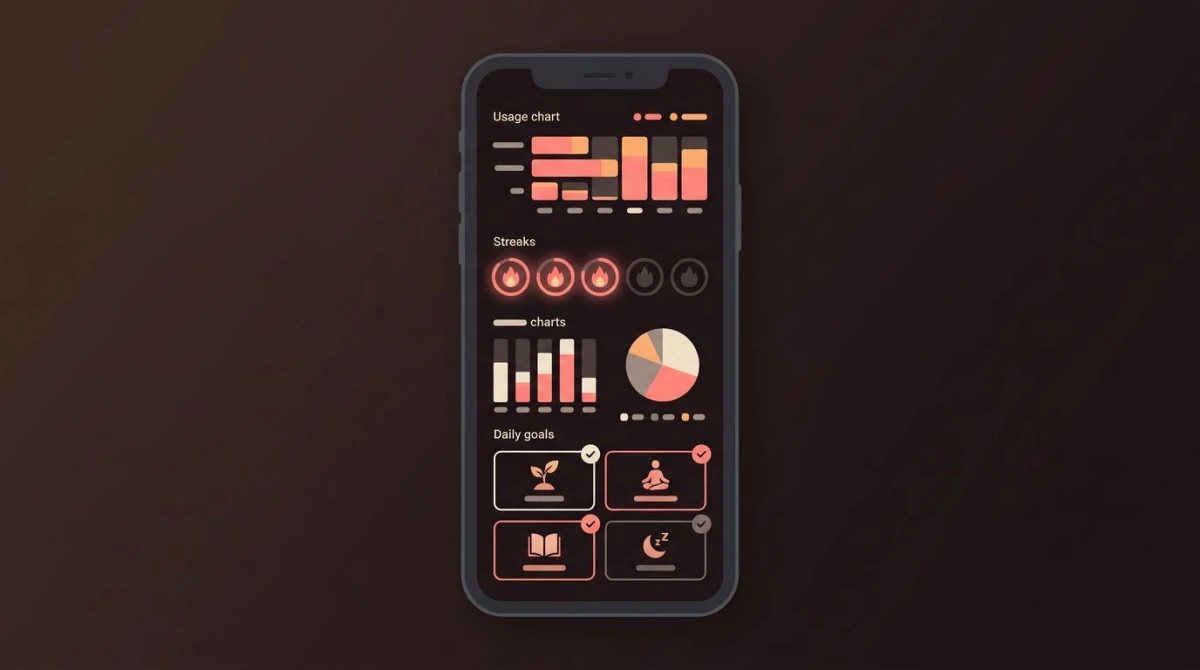
You can run this challenge with paper, but most finishers use a tracker because the streak is the engine. Each rule for the week is a yes/no row — tap each one once a day. The visible chain, and the small sting of breaking it, carries you across the days motivation dips. (More on why one tap a day beats spreadsheets in our tracking habits guide.)
A clean habit tracker like HabitBox lets you create one habit per rule, see the calendar fill with checkmarks, and get a quiet reminder when an anchor cue passes. No account needed — your streaks live on your phone, with optional iCloud sync on iPhone. The irony isn't lost on us: you're using the phone to use the phone less. The difference is this app closes when you're done.
Frequently asked questions
How long should a digital detox challenge last?
Do I have to give up my phone completely?
What if I have to use social media for work?
Will a 30-day detox change my habits long-term?
What should I do instead of scrolling?
Putting it into practice
To start today: open your screen-time settings, write down yesterday's number — that's day one. By day three you'll have a baseline. From there, the four-week plan does the work — one tap per rule, one day at a time.

Mira Hartwell
Editor, HabitBoxEditor at HabitBox. Writes about habit science and productivity, grounding every post in named research (Lally, Wood, Walker, Huberman) instead of recycled advice. Read full bio →