Mindfulness Habit: 10 Minutes a Day That Sticks
TL;DR. A mindfulness habit sticks when you anchor a 2-minute version to a cue you already run every day — the sessions naturally lengthen toward 10 minutes once the cue-routine loop is automatic. Research from University College London found new habits take a median of 66 days to feel automatic, so the goal of week one is not a perfect sit but a reliable rep. Pair the 2-minute floor with the never-miss-twice rule, pick one of four anchor cues below, and use the 30-day plan to ramp from 2 to 10 minutes without burning out. This is a habit guide, not medical advice — for clinical anxiety or depression, talk to a professional.
If you have tried meditation apps, sat for three days, and quietly let the habit slide — you are not lazy and you are not bad at mindfulness. The problem most adults hit is structural: a 10- or 20-minute target is too big for a habit that does not exist yet. The fix is not more willpower. It is a smaller starting size, a fixed cue, and a tracker that tells you the truth about your week.
This guide focuses on the habit-formation mechanics most articles skip. You get four anchor cues, a 30-day ramp from 2 to 10 minutes, the never-miss-twice rule for bad weeks, and a comparison table to match a cue to your schedule. The goal is a mindfulness habit still alive on day 60, not a perfect morning routine that lasts a week.
What is a mindfulness habit
A mindfulness habit is a daily, automatic practice of bringing attention to the present moment — through breath awareness, body scanning, or open noticing — without judgment. The "habit" part is the key word. A one-off 30-minute meditation when stressed is a coping move; a two-minute sit at the same cue every day is a habit. The habit version is what produces the steady mood, focus, and stress-tolerance gains people are actually after.
Mindfulness as a Western practice traces back to Jon Kabat-Zinn's 1979 MBSR program, which adapted Buddhist contemplative techniques into a secular eight-week clinical curriculum. His working definition — "paying attention, on purpose, in the present moment, non-judgmentally" — is still the cleanest one we have.
Mindfulness vs. meditation is mostly a scope distinction. Meditation is the formal sit — eyes closed, timer on, breath as anchor. Mindfulness is the broader skill of present-moment attention, which you practice during the sit and carry into the dishes, the commute, and the next hard conversation. A mindfulness habit usually starts as a daily meditation, because the formal sit is the easiest place to install the rep.
The science: why a 2-minute floor outperforms a 10-minute target
Most people fail at mindfulness for a structural reason, not a willpower one. The required effort is set higher than their motivation on their worst day. New behaviors collapse at the bottom of the motivation curve, not the top.
BJ Fogg, the Stanford behavior scientist behind the Tiny Habits method, calls this the motivation-effort match. Motivation moves up and down across a week — high on Sunday, low on Wednesday at 7am. Effort needs to fit the low point. Two minutes of mindful breathing fits a Wednesday morning. Ten minutes does not, which is why the ten-minute target gets skipped — and the skip becomes a quit.
Phillippa Lally and her team at University College London studied 96 people forming a new daily habit and found the median time to automaticity was 66 days, with a range from 18 to 254. Two findings matter most for mindfulness. First, the curve is steep early and flat later — the early reps build most of the automaticity. Second, missing one day did not measurably hurt habit formation, but missing two in a row did. That is where the never-miss-twice rule comes from.
The third pillar is cue stability. James Clear's Atomic Habits frames it as the cue-craving-response-reward loop. The practical takeaway: a fixed cue beats a fixed time. "After I pour my morning coffee, I will breathe for two minutes" runs without thinking by week three. "I will meditate at 7am" requires a willpower decision every morning, and willpower runs out.
The National Center for Complementary and Integrative Health summarizes the evidence: moderate-quality research supports modest improvements in stress, anxiety symptoms, depression symptoms, sleep, and chronic pain. Most studies use eight-week programs of 10 to 30 minutes a day, but the bigger gap is between zero minutes and any minutes, not between 10 and 20.

4 anchor cues compared: pick the one that fits your day
The cue is the hardest decision to get right and the easiest one to overlook. A good cue is something you already do every single day, in the same place, without thinking. The four below cover most adult schedules. Pick one. Do not switch for at least 14 days, even if it feels rough.
| Anchor cue | Trigger time | Best for | Why it works |
|---|---|---|---|
| Post-coffee | 7-8am | Morning people, parents | The pour-and-sip is already automatic; you are seated and warm |
| Post-shower | 7-9am | Shift workers, gym-goers | The shower is a stable transition point — you are calm and alone |
| Post-lunch | 12-1pm | Office workers, remote workers | Catches the afternoon energy dip; great for a body scan |
| Pre-bed | 9-11pm | Night owls, anxious sleepers | Pairs naturally with sleep hygiene and lowers cortisol before bed |
Two notes on this table. The "best for" column is a starting point, not a rule — if you are a parent who hates mornings, pre-bed will work better than post-coffee. And the trigger time is approximate; what matters is that the same cue happens every day, not that the clock reads the same number.
If you stack a mindfulness sit on top of an existing habit you already do reliably, you are using a technique called habit stacking. Our full habit stacking guide covers how to design and chain these cue-routine pairs, which is useful if you want to add a second wellness habit later.
How to actually build the habit: 6 steps
The habit-formation work front-loads in the first two weeks. After that, automaticity does most of the heavy lifting. These six steps are the install protocol.
1. Pick one cue and write the sentence
Choose one anchor from the table above. Then write the sentence in this exact format: "After I [cue], I will breathe for two minutes." Say it out loud. Put a sticky note on the kitchen counter or the bathroom mirror if you need to. The sentence is the contract.
2. Set the floor at 2 minutes — not 10
Two minutes is the floor, not the target. The floor is the minimum that still counts as a rep. On a slow Sunday you might sit for 12 minutes; on a brutal Tuesday you do 2 and stop. Both days count the same toward the habit. That sameness is what protects the practice when life gets messy.
3. Use one technique for the first two weeks
Pick one of three beginner-friendly techniques and run it for 14 days without switching:
- Breath count to 10 — Count each exhale up to ten, then start over. If you lose count, restart at one. No drama.
- Body scan — Move attention slowly from feet to head, noticing sensation without changing it.
- Noting — When a thought appears, label it gently ("thinking", "planning", "worry") and return to the breath. Labelling emotions this way is the same mechanism that makes the best mood tracking apps effective — naming a feeling measurably lowers its intensity.
Switching techniques in week one feels productive but reads to your brain as starting over. Pick one. Stick with it.
4. Lower the friction
Put your phone on do-not-disturb the night before. Pick a spot — a chair, a corner of the couch, a cushion — and leave it ready. If you use an app, open it once, set a 2-minute timer, and close it. The decisions you make at 9pm tonight are easier than the decisions you will make at 7am tomorrow.
5. Track the rep, not the streak
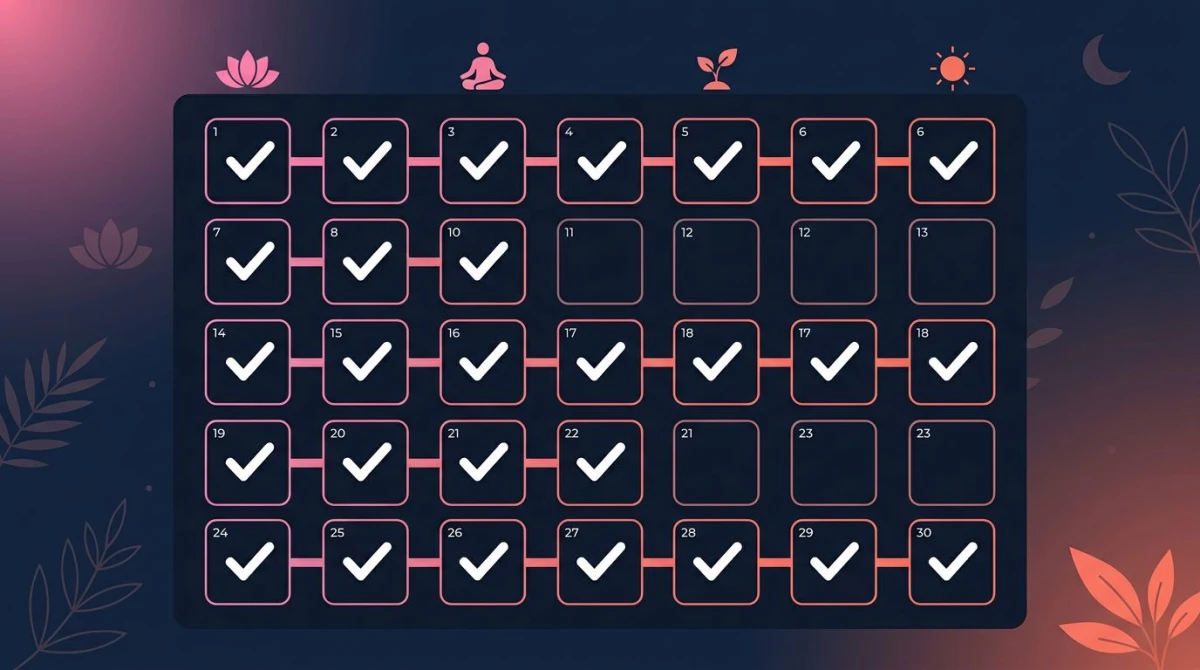
Track whether you sat, not how it felt. Most people quit after one bad sit because they conflate "the sit was fidgety" with "I failed". A bad sit is still a rep. Mark it done. The visual feedback of a daily check matters more than the quality of any one session.
A simple tracker app like HabitBox makes this easier — you mark mindfulness as done, see the streak grow on a calendar heatmap, and the visual progress quietly reinforces the habit during the awkward first three weeks. The clean check-in is the whole point; you are not journaling the sit, you are confirming the rep.
6. Apply the never-miss-twice rule
Missing one day is not a failure. Missing two in a row is the start of a quit. If you skip a day, the next day is a hard non-negotiable, even if it is 60 seconds in your car before walking into the office. This rule alone saves more practices than every other technique combined.
The 30-day mindfulness habit plan
The 30-day plan keeps the cue stable and ramps the length by one minute per week. Length is the only variable. Cue, technique, and time of day stay constant for the full month. This is on purpose — your brain needs the repetition to wire in the loop.
| Week | Length | Cue | Technique | Goal |
|---|---|---|---|---|
| 1 (Days 1-7) | 2 min | Same daily anchor | Breath count to 10 | Install the cue |
| 2 (Days 8-14) | 4 min | Same daily anchor | Breath count to 10 | Hit 7 reps |
| 3 (Days 15-21) | 6 min | Same daily anchor | Body scan | Try a second technique |
| 4 (Days 22-30) | 8-10 min | Same daily anchor | Pick your favorite | Settle into the longer sit |
A few notes on the ramp. Length increases when the week rolls over — Monday Day 8 jumps from 2 to 4 minutes. If a longer length feels rough, drop back for two more days and try again; there is no penalty. Week 3 introduces a second technique because by then the cue is stable. Week 4 lands at 8 to 10 minutes, which is the sweet spot most research uses for adult mindfulness practice. Past day 30, do not add more length — length above 15 minutes does not produce proportionally bigger gains for most people, and it adds friction.
When it doesn't work: the recovery rules
Every mindfulness habit hits rough weeks — travel, illness, a hard work month. The recovery rules below keep a wobble from becoming a quit.
Rule 1: Never miss twice in a row. A single missed day is statistically irrelevant — Lally's UCL data showed no measurable effect on habit formation. Two in a row is when the cue starts to weaken. If you missed yesterday, today is mandatory, even if the rep is 60 seconds of breath count in a parking lot.
Rule 2: Drop the length, never the cue. On a brutal week, do not skip — shrink. A 30-second mindful breath at the cue is a rep. The cue is where the automaticity lives. Once you drop the cue, you are restarting from scratch.
Rule 3: Reset, do not quit. If you have missed five or more days, the cue is gone. Treat it as a fresh install: pick the cue again, drop back to 2 minutes, run week one of the plan. Do not try to pick up where you left off. Reinstall usually takes three to seven days, much faster than the original.
Rule 4: Watch for "I'm bad at this." A wandering mind is the practice, not a sign of failure. The noticing and returning is the rep. If you sat for two minutes and your brain ran the entire grocery list, you did the practice correctly.
A note on harder territory. If a mindfulness habit triggers persistent distress, dissociation, or trauma symptoms, stop and talk to a mental health professional. Mindfulness can surface difficult material for some people, and a clinician-guided approach is safer. This guide is for general lifestyle habit-building, not clinical treatment.
How to track a mindfulness habit without overthinking it
The tracking is doing more work than people realize. The visual check on a calendar heatmap is what makes the rep feel real in weeks two and three, when the practice is not yet automatic and there is no obvious reward. A paper calendar with an X each day works. A tracker app with a streak count and a heatmap works better. The mechanism is the same: a visual cue that says "you did it again".
A few things worth tracking past the basic check:
- Cue consistency. Did the sit happen at your anchor cue, or somewhere random? Random sits are fine, but they do not build the cue-response loop the same way.
- Length, not quality. Two minutes vs. ten minutes is a useful data point. "How peaceful did I feel" is not — it is too noisy and prone to making a bad day feel like a failure.
- Missed-day pattern. If you keep missing the same day of the week, the cue is wrong for that day. Adjust.
For more on the mechanics of habit automaticity, our habit formation guide goes deeper.
How to graduate past 10 minutes
Around day 45 to 60, the 10-minute sit will feel small. Two paths work. The first is depth — keep the sit at 10 minutes and add a body scan after the breath count, or layer in a brief loving-kindness practice at the end. The second is dosage — add a second short sit at a different cue (post-lunch is a good slot). If you take the dosage path, install the second sit the same way you installed the first: pick the cue, run a 2-minute floor for two weeks. Do not add the second sit until the first is fully automatic. For more on formal sitting practice, see our meditation starter guide.
FAQ
What is a mindfulness habit?
How long until mindfulness becomes a habit?
Mindfulness vs. meditation: what is the difference?
What is the best time of day for mindfulness?
How do I keep my mindfulness habit on busy days?
The takeaway
A mindfulness habit is built, not summoned. The honest version of the work is a 2-minute floor anchored to a cue you already run, held flat for two weeks, then ramped to 10 minutes by day 30 — with the never-miss-twice rule covering the rough patches. Most people who fail at mindfulness do not fail at the meditation; they fail at the install protocol around it.
If you want a cleaner way to track the rep — a calendar heatmap, current and longest streaks, a single check-in that takes one second — HabitBox is built for exactly this kind of daily habit. Add "mindfulness" as a habit, set your reminder at your anchor cue, and let the visual streak do the quiet work of keeping you honest. The habit is the goal. The 10-minute sit is just the eventual size.

Mira Hartwell
Editor, HabitBoxEditor at HabitBox. Writes about habit science and productivity, grounding every post in named research (Lally, Wood, Walker, Huberman) instead of recycled advice. Read full bio →