New Year's Resolution Ideas: 40 You Can Track Daily
TL;DR: The best New Year's resolution ideas are ones you can do every day in a small dose: read 10 pages, walk 10 minutes, move $5 to savings, write three lines. Below are 40 ideas in six areas, each with a daily version, a starting dose and a way to track it. Pick one or two, not ten.
Most lists of New Year's resolution ideas stop at the wish: get healthier, save money, read more. Those are fine directions, but they don't tell you what to do on a cold Tuesday in the middle of January.
This list goes one step further. Each idea comes with three things: a daily version (the action itself), a starting dose small enough for a bad day, and a track it as line, so you know what to check off tonight. The few weekly and monthly ideas are labelled as such.
You won't find success-rate numbers here. If you want to know how many resolutions stick, that has its own post. This one is about what to pick and how to start.
How to turn a resolution into a daily habit
A resolution is a direction. A habit is something you do today. To get from one to the other, give each idea three parts:
- A daily version. A verb you can do today, ideally after a cue you already have. "Walk after lunch" works. "Get fit" doesn't.
- A starting dose. The amount you can manage on your worst day, like 10 minutes or 2 pages. It should feel almost too easy. Our guide to micro-habits explains why tiny starts are easier to repeat.
- A way to track it. Pick one of three types: yes/no (did it or didn't), a count (pages, glasses, dollars) or minutes. You check it off once a day.
Next, word it as something to start, not something to stop. A 2020 study in PLOS ONE by Oscarsson and colleagues followed 1,066 Swedish-speaking adults through a year of resolutions. Among those who answered at the one-year check, 58.9% of people with approach goals (aiming to do something) rated themselves successful, against 47.1% of people with avoidance goals (aiming to stop something).
That's a self-rating and a small effect, but rewording costs nothing. "Eat a vegetable with dinner" is an approach goal. "Stop eating junk" is an avoidance goal.

Last, tie the new action to something you already do every day. "After I pour my morning coffee, I write three lines" is easier to remember than "write more." That's habit stacking, and most ideas below suggest a cue you can borrow.
Here's the same move applied to eight resolutions that usually get written in vague terms:
| Resolution as usually written | Daily version | Starting dose | Track it as |
|---|---|---|---|
| Exercise more | Walk after lunch | 10 minutes | Minutes |
| Eat healthier | Add a vegetable to dinner | One handful | Yes/no |
| Save money | Move money to savings each morning | $5 | Count (dollars) |
| Read more | Read in bed before lights out | 10 pages | Count (pages) |
| Sleep better | Get up at the same time every day | Within 30 minutes of your target | Yes/no |
| Drink less | Pour an alcohol-free drink on weeknights | Monday to Thursday | Yes/no |
| Spend less time on my phone | Start the morning phone-free | 15 minutes after waking | Yes/no |
| Learn a language | Do one lesson after dinner | 10 minutes | Minutes |
Notice two rewrites. "Drink less" becomes something to pour, and "less phone time" becomes a phone-free start to the day. The goal stays the same; only the wording turns toward action.
Health and fitness New Year's resolution ideas
Health goals are the easiest to write vaguely and the easiest to make concrete. Each idea below is one action you can picture yourself doing tomorrow. The guideline figures come from US public health sources, checked November 2026.
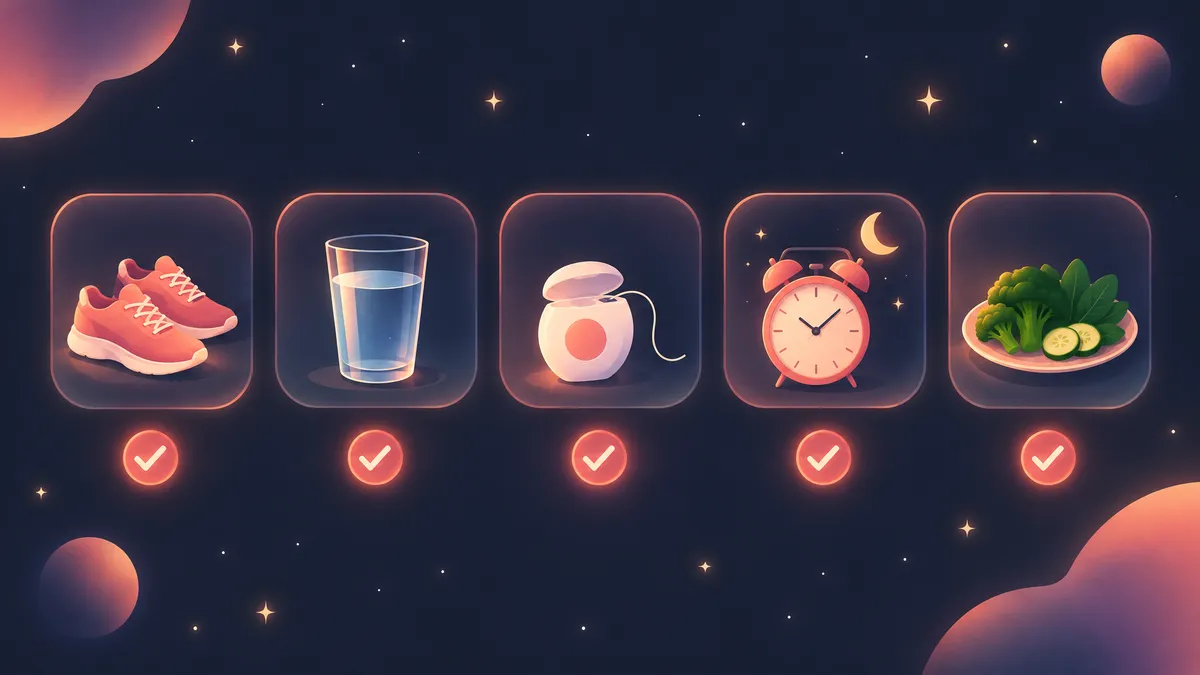
None of these is a diet or a weight target. If you have a health condition, check with your doctor before you add exercise or change how you eat or drink.
1. Walk every day
The US Physical Activity Guidelines ask adults for at least 150 to 300 minutes of moderate activity, like brisk walking, each week. A short daily walk is the simplest way to start on that.
Daily version: a walk after lunch. Starting dose: 10 minutes. Track it as: minutes.
2. Stretch when you get up
Stiff mornings respond better to a habit than to a plan. Keep it tiny so it survives a rushed day, and do it beside the bed before you pick up your phone.
Daily version: stretch right after you get out of bed. Starting dose: 2 minutes. Track it as: yes/no.
3. Strength-train twice a week (weekly)
The same guidelines add muscle-strengthening activity, like push-ups or lifting weights, on at least 2 days each week. Pick your two days in advance so the choice is already made.
Weekly version: a short bodyweight session on your chosen days. Starting dose: one set each of squats, wall push-ups and a plank. Track it as: yes/no, with a goal of 2 days a week.
4. Get up at the same time every day
Experts recommend 7 to 9 hours of sleep a night for adults, according to the NHLBI. A steady wake time, weekends included, gives the rest of your sleep schedule something to hang on. Count back from it and set a second alarm for bedtime.
Daily version: get up at the same time, weekends too. Starting dose: within 30 minutes of your target. Track it as: yes/no.
5. Add a vegetable to dinner
"Eat healthier" gives you nothing to do at 7 p.m. Adding one thing is easier than cutting things out, and it's an approach goal by design.
Daily version: put a vegetable on your dinner plate. Starting dose: one handful, and frozen counts. Track it as: yes/no.
6. Pour an alcohol-free drink on weeknights
If you want to drink less, give yourself something to do, not only something to avoid. Pick a drink you enjoy, like sparkling water with lime or an alcohol-free beer, and make it the weeknight default. If cutting back feels hard, talk to your doctor.
Daily version: an alcohol-free drink with dinner on weeknights. Starting dose: Monday to Thursday. Track it as: yes/no.
7. Floss every night
The American Dental Association recommends flossing once a day, because a toothbrush can't fully clean between your teeth. Floss picks and water flossers count too.
Daily version: floss right after you brush at night. Starting dose: your front teeth only. Track it as: yes/no.
8. Drink a glass of water with each meal
Tie water to meals you already eat, and there's nothing extra to remember. Keep a glass or a bottle at your place at the table.
Daily version: a glass of water with breakfast, lunch and dinner. Starting dose: one glass with breakfast. Track it as: count (glasses), aiming for 3.
Money resolution ideas
Money resolutions tend to be one big number nobody looks at until December. Daily money habits are small and a bit dull, and that's fine. These are habits, not financial advice: how much you save and where it goes is your call.
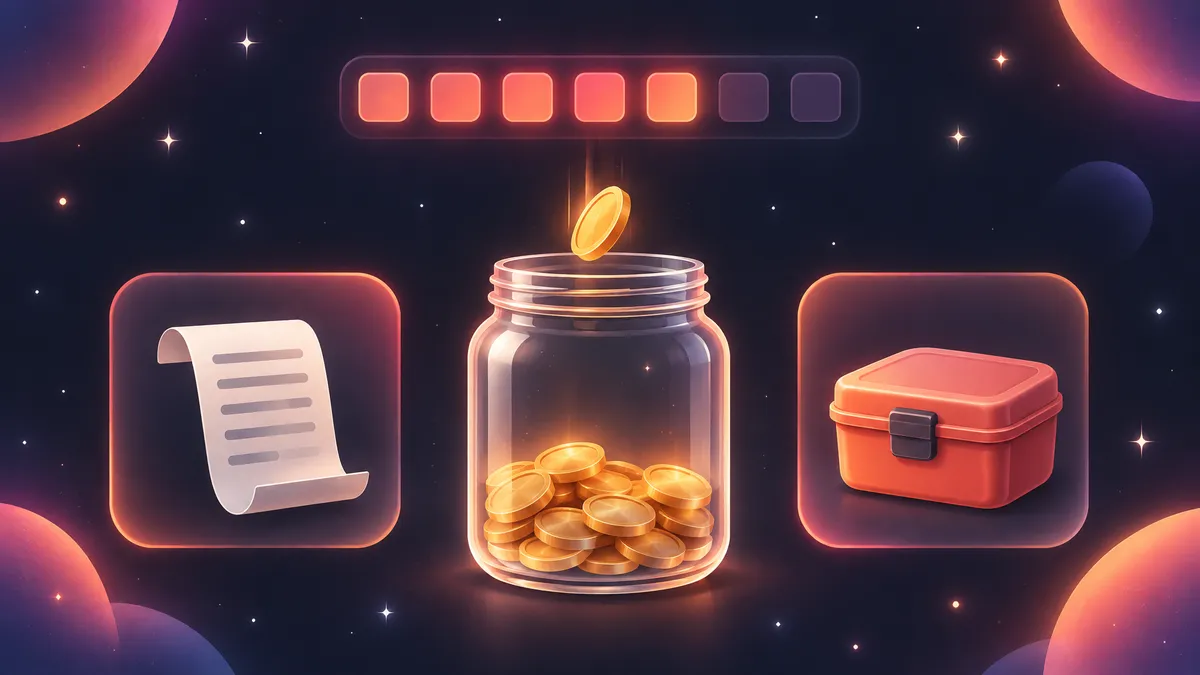
If you want to see where a daily amount leads, the savings goal calculator works out how much to set aside per day, week and month to reach a target by a date.
9. Log every purchase the same day
You can't change spending you don't see. A same-day log, in a notes app or your bank app's categories, keeps the picture honest.
Daily version: log today's purchases before bed. Starting dose: 2 minutes. Track it as: yes/no.
10. Have one no-spend day a week (weekly)
A no-spend day means no non-essential purchases; bills and planned groceries don't count against you. Our no-spend challenge guide covers the rules and how to build up to longer runs.
Weekly version: one set day with no non-essential spending. Starting dose: 1 day a week. Track it as: yes/no, with a goal of 1 day a week.
11. Move a small fixed amount to savings
A small amount you move by hand every day builds the habit of saving, whatever the total. At $5 a day, that's $1,825 over a year.
Daily version: move money to savings with your morning coffee. Starting dose: $5. Track it as: count (dollars).
12. Review one subscription a week (weekly)
Subscriptions are easy to forget because they renew on their own. Look at one each week and decide: keep, downgrade or cancel.
Weekly version: check one recurring charge on your chosen day. Starting dose: one subscription. Track it as: yes/no.
13. Pack lunch on workdays
Packing lunch only saves money if it's easy, so do it the night before while you clean up from dinner. Start with fewer days than you think you can manage.
Daily version: pack tomorrow's lunch after dinner. Starting dose: 2 workdays a week. Track it as: yes/no.
14. Wait 24 hours before non-essential buys
A short pause helps you tell a want from an impulse. When you feel the urge to buy something you didn't plan, add it to a wish list and decide tomorrow.
Daily version: put unplanned buys on a 24-hour list. Starting dose: anything over $20. Track it as: count (purchases you delayed).
15. Check your balance every morning
A one-minute look at your account keeps surprises small and makes the other money habits feel real. Pair it with your coffee or your commute.
Daily version: open your banking app and read the balance and upcoming bills. Starting dose: 1 minute. Track it as: yes/no.
Mind and mental health resolution ideas
These ideas are about attention and mood. They are small daily practices, not treatment, and if you're struggling, a doctor or licensed therapist is the right next step.

Each one fits into a few minutes, so it can survive a busy day. Pick the one that matches what you want more of: calm, focus or perspective.
16. Write three lines in a journal
A full page is a lot to ask every night. Three lines is enough to notice how the day went. If you get stuck, the journal prompt generator gives you a question to answer.
Daily version: three lines before bed. Starting dose: one line. Track it as: yes/no.
17. Breathe slowly for two minutes
Two minutes of slow breathing is a low-effort way to pause between tasks. The breathing timer paces each breath for you, and the meditation timer is there if you want to sit longer later.
Daily version: slow breathing when you sit down at your desk. Starting dose: 2 minutes. Track it as: minutes.
18. Keep the first 30 minutes phone-free
Starting the day with your own plans, not other people's messages, gives the morning a calmer start. Charge your phone outside the bedroom so it's harder to grab.
Daily version: no phone until after breakfast. Starting dose: 15 minutes after waking. Track it as: yes/no.
19. Set a daily screen-time limit
Your phone can enforce this for you. On iPhone, set a Time Allowance in Screen Time (iOS 26 and earlier call it App Limits). On Android, use app timers in Digital Wellbeing. Our screen time tracker guide covers more ways to see where the hours go.
Daily version: stay under a set limit for your most-used app or app category. Starting dose: 15 minutes less than today's total. Track it as: minutes.
20. Spend 10 minutes outside
Fresh air and daylight give your head a change of scene, even in January. A walk to the end of the street and back counts.
Daily version: time outside before dark. Starting dose: 5 minutes. Track it as: minutes.
21. Name one good thing at dinner
Gratitude doesn't need a special notebook. Say one thing that went well out loud at dinner, or type it into your phone's notes if you eat alone.
Daily version: one good thing, said or written, at dinner. Starting dose: one sentence. Track it as: yes/no.
22. Say no to one thing a week (weekly)
A full calendar leaves no room for the rest of this list. Practice turning down one request, meeting or plan you don't have space for, kindly and on purpose.
Weekly version: decline one thing you'd usually accept by default. Starting dose: one "no" a week. Track it as: count (things you declined).
Relationship resolution ideas
These ideas swap big gestures for small, regular contact you can put on a calendar. Pick the person first, then the habit.

"Call Mom on Sundays" is easier to keep than "be a better daughter." The weekly and monthly ideas are labelled, and each one still has a starting dose.
23. Text one person a day
A short message to a friend you haven't spoken to in a while keeps the connection warm. Keep a list of names so you don't spend the time deciding who's next.
Daily version: one message on your commute or lunch break. Starting dose: one line. Track it as: yes/no.
24. Eat one phone-free meal together
Put the phones in another room for one meal a day. It's an easy rule for everyone at the table to see and keep.
Daily version: phones away during dinner. Starting dose: three dinners a week. Track it as: yes/no.
25. Call a parent or close friend every week (weekly)
A set slot turns "I should call more" into a plan. Use time you already have, like a Sunday walk or a weekly drive.
Weekly version: one call on your chosen day. Starting dose: 10 minutes. Track it as: yes/no, with a goal of 1 day a week.
26. Give one specific compliment a day
"Nice job" is easy to forget. "You stayed calm on that client call" shows you were paying attention.
Daily version: one specific compliment to someone at home or at work. Starting dose: one sentence. Track it as: count (compliments).
27. Plan one date or friend night a week (weekly)
It doesn't have to cost much: a walk, a home-cooked meal or a board game counts. The habit is putting it on the calendar, not the event itself.
Weekly version: book the next one every Sunday. Starting dose: one hour together. Track it as: yes/no, with a goal of 1 day a week.
28. Write one handwritten note a month (monthly)
A card in the mail stands out in a pile of bills and ads. Keep a few cards and stamps where you can see them.
Monthly version: one note on the first weekend of the month. Starting dose: three sentences. Track it as: count (notes).
Learning and career resolution ideas
Learning resolutions often start as "learn Spanish" or "get better at work." What makes them stick is a fixed daily slot and a dose small enough for busy weeks.

The student idea is number 35. The reading idea, number 29, gets a full worked example after this list.
29. Read 10 pages a day
Ten pages a day is about a book a month if your books run around 300 pages. Our guide on how to read more books covers finding the time and the right book.
Daily version: read in bed before lights out. Starting dose: 10 pages, or one page on a bad night. Track it as: count (pages).
30. Practice a language for 10 minutes
Ten minutes a day keeps new words in front of you without eating your evening. Use whatever you already have, whether that's an app, a textbook or a podcast.
Daily version: one lesson after dinner. Starting dose: 10 minutes. Track it as: minutes.
31. Play an instrument for 10 minutes
Leave the instrument out of its case, on a stand where you'll see it. The less setup there is, the easier it is to start.
Daily version: play after dinner. Starting dose: 10 minutes, or one song. Track it as: minutes.
32. Write 250 words a day
At 250 words a day, a year adds up to more than 90,000 words. Write before you open email so the day can't crowd it out.
Daily version: write first thing at your desk. Starting dose: 50 words. Track it as: count (words).
33. Finish one lesson of a course
Treat a course like a TV series: one episode a day, not a weekend binge. Short daily lessons are easier to fit around work.
Daily version: one lesson at lunch. Starting dose: one lesson on weekdays. Track it as: yes/no.
34. Do one 25-minute focus block
One protected block on your hardest task moves it forward even on a messy day. Start the Pomodoro timer and close everything else.
Daily version: one focus block before lunch. Starting dose: one 25-minute block. Track it as: count (blocks).
35. For students: review notes after each class day
A short review on the same day means you meet the material twice before the exam, not once. Our study habits guide has more ideas for students.
Daily version: review the day's notes before dinner. Starting dose: 15 minutes. Track it as: minutes.
Home and lifestyle resolution ideas
Home resolutions make good first picks because you see the result the moment you finish. A made bed or a clear counter is its own small reward.
36. Make your bed
It takes a couple of minutes and gives you one finished task before breakfast.
Daily version: make the bed before you leave the bedroom. Starting dose: pull the covers up. Track it as: yes/no.
37. Do a 10-minute evening reset
Set a timer and put the main room back in order: dishes away, shoes away, counters clear. Tomorrow starts with a clean slate.
Daily version: a reset after dinner. Starting dose: 10 minutes. Track it as: minutes.
38. Cook at home on set nights (weekly)
Pick the nights first, then the meals. Cooking on a schedule is easier than deciding at 6 p.m. when you're already hungry.
Weekly version: cook dinner at home on fixed nights. Starting dose: 3 nights a week. Track it as: yes/no, with a goal of 3 days a week.
39. Remove one item a day
Donate, recycle or throw away one thing you don't use. Over a year that's 365 fewer things, with no weekend-long purge.
Daily version: one item into a donation bag each evening. Starting dose: one item. Track it as: count (items).
40. Try one new recipe a week (weekly)
A new recipe a week keeps home cooking from getting boring, and it pairs well with idea 38. Choose it on the weekend so you can shop for it.
Weekly version: cook one new recipe on a set night. Starting dose: a recipe with five ingredients or fewer. Track it as: yes/no, with a goal of 1 day a week.
Worked example: one resolution through the SMART goals generator
Here's one idea from the list run through a real tool. Our free SMART goals generator turns a goal into a one-line statement, then suggests a supporting habit and a milestone schedule. The method behind it is covered in how to set goals.
These are the inputs for idea 29, reading:
| Field | Input |
|---|---|
| Specific | read 12 books |
| Measurable | 10 pages a day, checked off daily |
| Achievable | Stretch — challenging but realistic |
| Relevant | I want to read more than I scroll |
| Time-bound | December 31, 2027 |
Type the Specific field in lower case, because the tool drops it straight after "I will." With these inputs, the tool writes this statement:
By December 31, 2027, I will read 12 books, measured by 10 pages a day, checked off daily. This matters because I want to read more than I scroll.
It then picks a supporting habit from the words "read" and "pages": Read 10 pages every night before bed. Its first-week tiny version is Open the book and read one page. For the first seven days, that one page is the whole job.
The tool also splits the time between the day you run it and the deadline into four equal parts. Run on January 1, 2027, the checkpoints land on these dates:
| Checkpoint | Date | Share of the goal | Books (12 × share) |
|---|---|---|---|
| Checkpoint 1 | Apr 2, 2027 | 25% | 3 |
| Checkpoint 2 | Jul 2, 2027 | 50% | 6 |
| Checkpoint 3 | Oct 1, 2027 | 75% | 9 |
| Goal date | Dec 31, 2027 | 100% | 12 |
The dates shift with the day you run it. With the same inputs on November 15, 2026, the first three checkpoints move to Feb 25, Jun 8 and Sep 19, 2027.

Does 10 pages a day add up to 12 books? Here's the math, with one assumption. Ten pages a day for a year is about 3,650 pages, and if your books run about 300 pages each, that's roughly 12 books.
Longer books mean fewer finished, and that's fine. The yearly number sets the direction; the 10 pages are what you check off each night. Every idea on this list follows the same pattern: one goal, one daily action, one check-off.
How to track your resolution
Whichever idea you pick, give it one habit in a tracker. Use the daily version as the habit's name, the starting dose as its target, and set a reminder at your cue time.
HabitBox is built around that loop. Each habit gets a streak and a calendar heatmap, so a gap is easy to spot and a run of filled days is easy to protect. Pick the habit type that matches your "track it as" line:
- Completable for yes/no ideas, like flossing or making the bed.
- Trackable for open counts, like glasses of water, dollars saved or compliments given.
- Goal-Oriented for a daily target you want to hit, like 10 pages or 10 minutes.
For the weekly ideas, open Schedule, choose Weekly goal and set how many days per week, from 1 to 7.
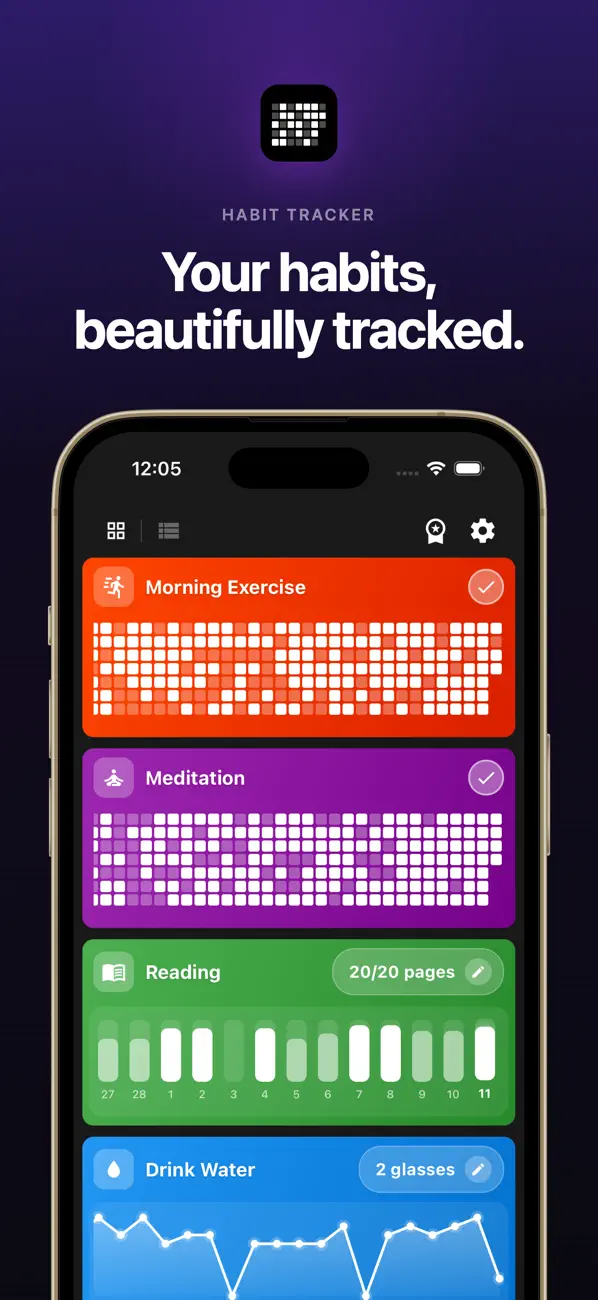
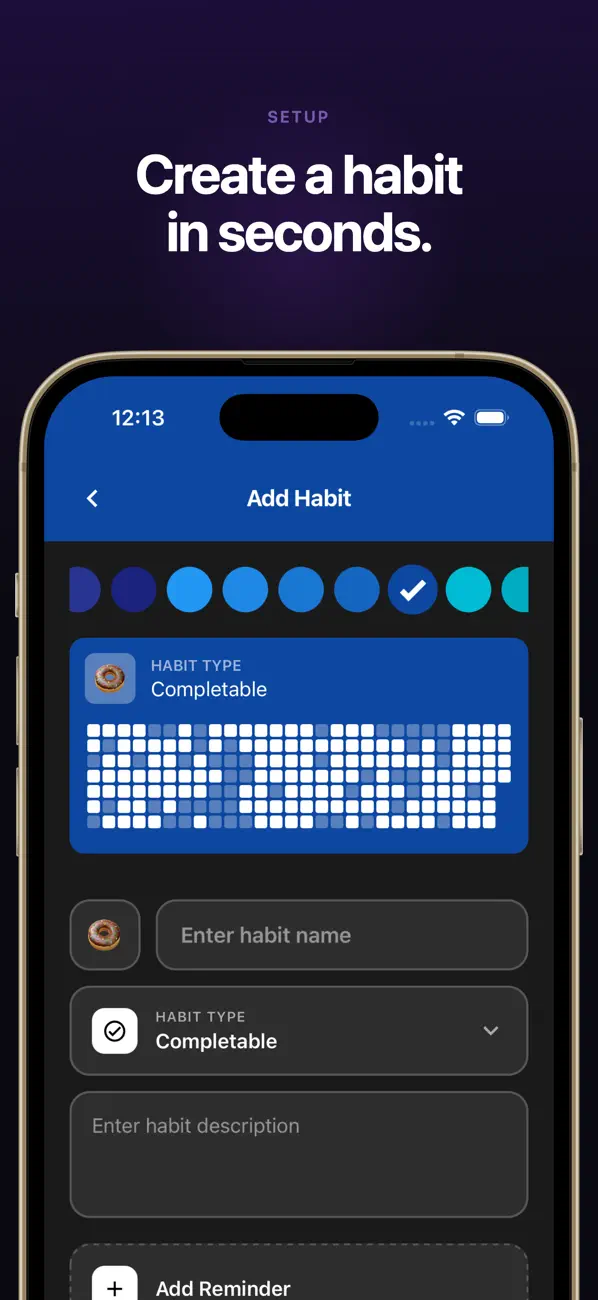
HabitBox is free to start, with up to 2 active habits and 1 reminder per habit on the free plan, which fits the one or two resolutions this list suggests. Plus adds more active habits, multiple reminders per habit, and backup file export and import. There's no account to create, and your habits stay on the device, with optional iCloud sync on iPhone.
One missed day doesn't erase your progress. Start again the next day, and if you want the longer view, our post on how long it takes to build a habit explains why the restart matters more than a perfect record.
FAQ
What's a good resolution for the new year?
What are some fun New Year's resolution ideas?
How many New Year's resolutions should you make?
What are good New Year's resolutions for students?
What are good goals for the year?
Is it too late to start a resolution after January 1?

Mira Hartwell
Editor, HabitBoxEditor at HabitBox. Writes about habit science and productivity, grounding every post in named research (Lally, Wood, Walker, Huberman) instead of recycled advice. Read full bio →