Habitica Review 2026: Is the RPG Habit Tracker Worth It?
Habitica turns your to-do list into a retro role-playing game. Check off a task and your avatar earns gold and experience. Miss one and you take damage. This Habitica review covers what the app costs in 2026, what it genuinely does well, where it breaks down, and who should pick something plainer instead.
Short version: Habitica is the most committed gamified tracker on either app store, and it is free to use for as long as you like. It is also the one most likely to punish you on a bad week, and it still cannot draw you a chart of your own progress. Whether that trade works depends almost entirely on whether you like games.
What Habitica is, in plain terms
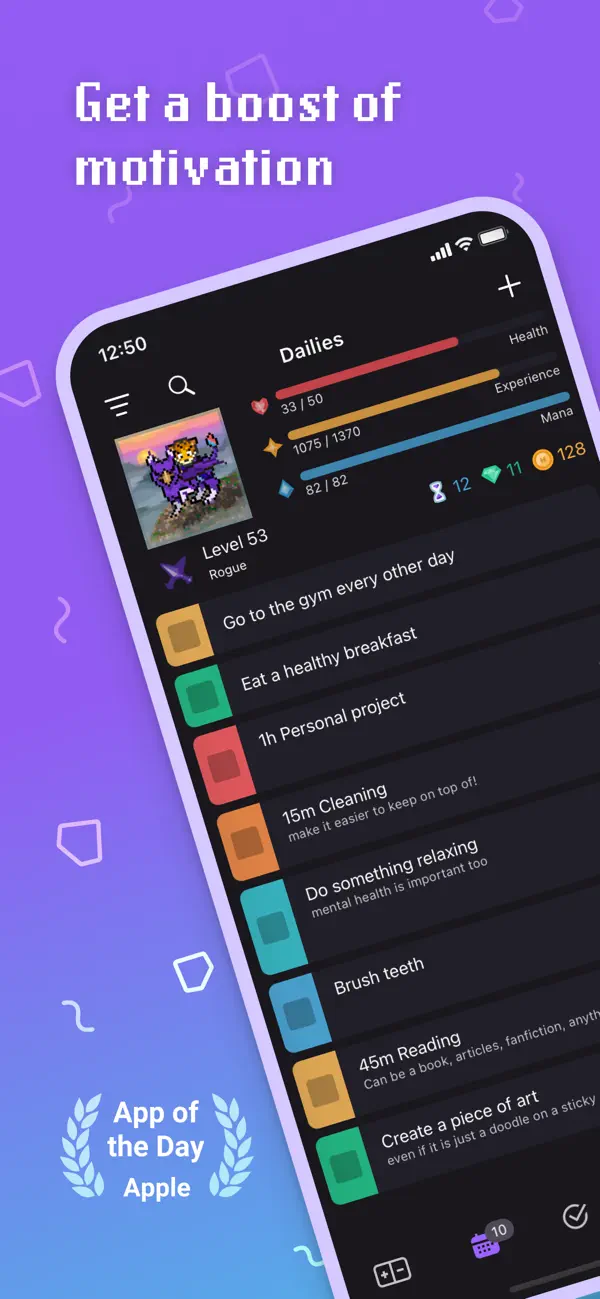
Habitica is a task manager wrapped in a 16-bit RPG. You build an avatar, and every task you finish feeds that character.
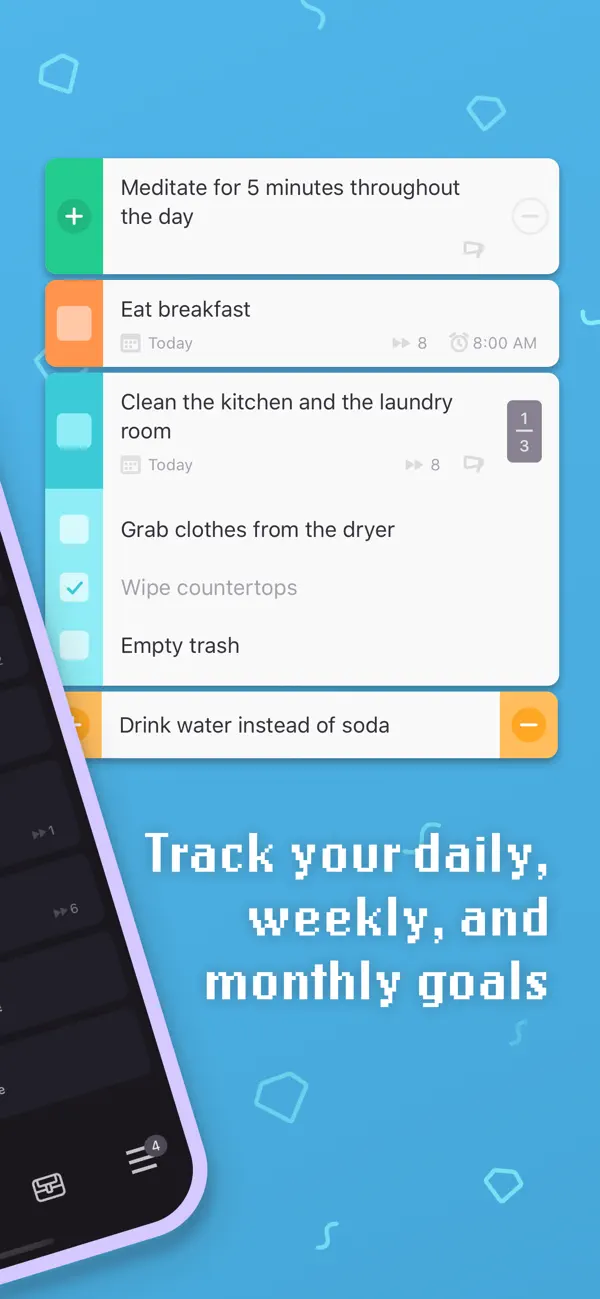
The app splits your work into three types, and the split matters more than new users expect:
- Habits are things you do at odd times, or many times a day. They have a plus button, a minus button, or both.
- Dailies are scheduled repeats. These are the ones that hurt. Miss a Daily and your character loses health.
- To Do's are one-off tasks. They pay out when you finish them and never cost you health.
Tasks also change color. New ones start yellow, drift blue when you keep up, and turn red when you keep missing them. Red tasks pay the most gold and experience, which is a clever nudge toward the work you have been dodging.
Everyone starts as a Warrior. At level 10 you pick a class — Warrior, Healer, Mage or Rogue — or opt out of the class system entirely from Settings. Each class has its own skills and gear.
Gold is the currency you earn by working, and it has real uses. A Health Potion costs 25 gold and restores 15 health. The Enchanted Armoire costs 100 gold a pull and holds over 350 pieces of gear, food and experience. Leveling up also refills your health bar completely.
Habitica runs on iPhone, Android and the web, and the code is open source on GitHub. You do need an account, because everything syncs through Habitica's servers. There is no guest mode.
Habitica pricing in 2026: what is free and what is not
The core loop is genuinely free. Tasks, streaks, reminders, parties, quests and the whole leveling system cost nothing.
What money buys is the shop. Habitica runs two currencies: gold, which you earn by working, and gems, which you mostly buy. Gems unlock cosmetic gear, avatar customizations, backgrounds and some quest scrolls.
| Subscription | Price | Works out at |
|---|---|---|
| 1 month | $4.99 | $4.99 / month |
| 3 months | $14.99 | $5.00 / month |
| 6 months | $29.99 | $5.00 / month |
| 12 months | $47.99 | $4.00 / month |
| Group Plan | $9.00 / month + $3.00 per extra member | Covers the leader plus paid seats |
A subscription does not remove a paywall, because there is no paywall on the task tracking. It gives you monthly mystery gear, an exclusive pet, double item drops, more exported task history, a Mystic Hourglass each month, and the right to buy gems with gold at 20 gold each. That last one is the real perk. Non-subscribers can only buy gems with money or win them in a challenge.
If you would rather buy gems outright, the packs are priced as follows.
| Gem pack | Price |
|---|---|
| 4 Gems | $0.99 |
| 21 Gems | $4.99 |
| 42 Gems | $9.99 |
| 84 Gems | $19.99 |
Two more notes on cost. Group Plans give every member full subscriber benefits, so a family of four at $18 a month is close to four separate subscriptions and easier to manage. And Google Play flags the Android build with a "Contains ads" badge, while Apple's listing does not.
What Habitica does well
It gives boring tasks a scoreboard. Flossing pays gold. Gold buys a hat. That is silly, and for a lot of people it works anyway. Habitica is by far the most complete example of gamifying your life in a single app.
The red-task mechanic is smart design. The longer you avoid something, the bigger the payout. Most trackers treat every check-in the same. Habitica quietly points you at the task you keep skipping.
Parties create real accountability. A party holds up to 30 people, and you take on a boss together. Your missed Dailies damage the whole party, and their finished tasks damage the boss. Social pressure is doing the work, not the pixel art.
It is free without being stingy. Nothing about tracking, scheduling or reminders is gated. The paid layer is cosmetics and convenience, and Habitica's own documentation is explicit that subscribers do not advance faster.
It has a genuine following among ADHD users. Scroll the recent App Store reviews and the word appears constantly. Novelty, immediate feedback and visible rewards are exactly what a plain task list lacks. It is one of the more interesting productivity apps for ADHD for that reason, though that is a pattern in user reviews, not a clinical finding: how anyone responds to game rewards is not set by a diagnosis.
Where Habitica falls short
The damage system punishes your worst weeks
Miss your Dailies and you lose health. Hit zero and you lose a level, that level's stat point, all your gold, and a piece of equipment.
That design assumes a missed day is laziness. Often it is flu, a deadline, or a rough mental-health stretch. Recent one- and two-star reviews say this plainly, including one from a chronically ill user who did not want to be punished twice for being too sick to work.
There is a fix, and new users rarely find it: a Pause Damage switch in Settings stops the health loss while you are away. Turn it on before a vacation or a hard week. Without it, the app amplifies exactly the all-or-nothing thinking that ends most habit streaks.
There are no progress charts
This is the one that surprises people. Habitica's own in-app FAQ says it directly: the app does not offer a visual representation of your task data over time.
Your character's level is the only long-run progress signal, and level conflates everything — chores, work, workouts — into one number. You cannot see that you flossed 26 days out of 30 last month.
You can export your task data from the Site Data tab on the website and build the chart yourself, which most people will never do. If tracking habits means looking at your own patterns, this is a real gap.
The fun stuff sits behind gems
Gold buys practical items. Gems buy the things people actually want: hairstyles, backgrounds, seasonal outfits, certain quests. Without a subscription there is no reliable free route to gems, and the review pages fill up with variations of the same complaint.
To be fair, none of it affects your ability to finish tasks. But when the entire pitch is "make chores feel like a game", a locked wardrobe lands harder than it would elsewhere.
Guilds and the Tavern are gone
Habitica shut down its Tavern and all public and private Guilds on 8 August 2023, citing low usage and content-moderation requirements. Parties, Challenges and Group Plans survived, and you can still browse public Challenges from the Discover Challenges tab. What went with the Guilds were the Challenges hosted inside them. Those stayed open to people already in them, but dropped off the public list, and no new Guild-based ones can be made.
Long-time users still grieve this in reviews, and it is worth knowing before you download. Apple's App Store description, oddly, still lists Guilds as a feature three years on.
It gets buggy
Across 200 recent US App Store reviews, 71 sat at three stars or below. The repeat offenders: home-screen widgets that stop updating, crashes after big releases, day-reset glitches, and slowdowns during avatar setup. Habitica's US App Store score is 4.3 from about 3,300 ratings, well under the 4.7 it holds on Google Play from 75,000 reviews.
Does the RPG layer actually build habits?
The research is more encouraging than skeptics expect, and less magical than the pitch suggests.
A 2022 systematic review in the Journal of Medical Internet Research pooled 16 randomized controlled trials covering 2,407 people. Gamified interventions beat controls on physical activity with a small-to-medium effect (Hedges g = 0.42). They also beat non-gamified behavior programs head to head, which is the harder test.
Then comes the catch. At follow-up, averaging about 14 weeks after the intervention ended, the effect had shrunk to g = 0.15. Still positive. Much smaller.
That maps neatly onto what Habitica reviewers describe. The first month is fun. Month six is a chore list with a hat shop attached. Points are extrinsic motivation, and extrinsic motivation is a good starter engine rather than a good permanent one.
The practical read: use the game to get through the first six to eight weeks, and pay attention to whether the behavior survives once the novelty fades.
Who Habitica is for
| If you are… | Habitica fit |
|---|---|
| A gamer who likes loot, levels and pixel art | Strong. Nothing else comes close. |
| Motivated by a small group working together | Strong. Parties are the best feature. |
| Managing ADHD and bored by plain checklists | Often strong. Try Pause Damage early. |
| Tracking a handful of health habits | Weak. Too much machinery for five check-ins. |
| Recovering from illness or a burnout stretch | Weak. The damage model works against you. |
| Someone who wants charts and completion rates | Weak. The app does not draw them. |
| Looking for a two-minute daily ritual | Weak. Setup alone takes longer than that. |
Cost is rarely the deciding factor here, since the free tier is fully usable. The deciding factor is patience for the game.
If you do try it, three moves make the first month go better. Start with three or four Dailies, not twenty, because every one you add is a new way to take damage. Turn on Pause Damage before any week you already know will be messy. And skip the class system until level 10 rather than reading the wiki on day one.
If the RPG layer is the part you want gone, that is a common enough exit that we wrote it up separately: our guide to the best Habitica alternatives compares seven simpler trackers side by side, including free picks for both platforms. Most of them trade the avatar for the thing Habitica lacks — a calendar heatmap and completion stats you can read at a glance. HabitBox sits in that group, with one-tap check-ins and no account required, free to start with an optional Plus upgrade. Disclosure: that one is ours, so treat it as a description rather than a verdict.
Habitica review verdict: is it worth it in 2026?
Habitica is worth it if the game is the point. For an RPG fan who has bounced off three plain checklists, the avatar, the loot and the party quests are not decoration — they are the reason the app gets opened at all. That crowd should download it today and pay nothing.
Everyone else should think twice. The setup is long, the damage system is unkind on bad weeks, the analytics are absent, and the parts that look most fun are the parts you buy. A subscription at $47.99 a year is fair value for someone deep in the world and pointless for someone using it as a chore list.
Verdict: brilliant for the right player, heavy for everyone else.
FAQ
Is Habitica free?
How much does a Habitica subscription cost?
What happens if you miss a day in Habitica?
Does Habitica show your habit statistics?
Is Habitica good for ADHD?

Mira Hartwell
Editor, HabitBoxEditor at HabitBox. Writes about habit science and productivity, grounding every post in named research (Lally, Wood, Walker, Huberman) instead of recycled advice. Read full bio →