How to Do 100 Pushups: 6-Week Daily Program (2026)
The "100 pushups" goal is one of the cleanest fitness benchmarks out there. No gym, no gear, six weeks for most adults if you run a proper ladder. This is the form-strict, streak-based version of the program — plus a smart-rest tweak that addresses the daily-vs-rest debate. If you'd rather run a fixed 30-day version, head over to our 30-day pushup challenge — the article you are reading aims at a different target: 100 reps total in a day, not a 30-day fixed count.
TL;DR
Most untrained adults can hit 100 pushups in a day within 6 weeks using a graduated ladder of 5 sets per day, 6 days a week, with one rest day. The program scales the daily total based on your starting max. Form is non-negotiable — chest to fist height, elbows at 45°, plank line from heel to head. Track the daily rep on a habit tracker — or, for full set-and-rep logging, see our workout tracker app comparison. Most who stall do so because they skip rest, cheat range of motion, or quit at week 3.
Quick answer: To go from zero to 100 pushups, take a max-rep test today (good form, no cheating). Then run the 6-week program: 5 sets per day, totaling 30 to 100 reps depending on your starting number, six days a week with one rest day. Add 5 to 10 reps per week. Track every day on a streak. Most adults hit 100 in week 6.
How this differs from a 30-day challenge
A quick comparison so you pick the right one:
| Program | Goal | Daily structure | Best for |
|---|---|---|---|
| This 6-week program | 100 reps in a single day, broken into 5 sets | Graduated ladder, 6 days/week + 1 rest | Building toward a clean 100/day total |
| 30-day pushup challenge | A fixed 30-day reps schedule | Set count by day | Quick habit install + visible progress in a month |
This article is for the first goal. The structure below is adapted from the canonical hundredpushups.com framework, with a tighter rest schedule that addresses Jeff Cavaliere's (AthleanX) overuse argument.
Step 1: Take the starting test
Before anything, find out where you actually are. Warm up for 2 minutes (arm circles, shoulder rolls). Then do as many good-form pushups in a row as you can. Stop when form breaks — sagging hips, partial range of motion, head jutting. Don't grind through bad reps; they don't count.
Record the number. That is your baseline. Most beginner adults land in one of three bands:
- 0 to 5 reps: Start with knee or incline pushups. Run the program at knee level. Switch to standard form when you can do 10 standard reps in a single set.
- 6 to 15 reps: Use the "low" version of the table below.
- 16 to 30 reps: Use the "mid" version.
- 30+ reps: Use the "high" version. You will likely hit 100/day in 4 weeks instead of 6.
Honesty matters. Inflating the baseline ruins the whole program because the first week's volume is calibrated to your real strength.
Step 2: Learn the non-negotiable form rules
Bad reps don't build strength. They build patterns the shoulder later pays for. Five rules:
- Plank line. Head, hips, and heels in one straight line. No sagging hips. No upward butt.
- Hands shoulder-width. Slightly wider is fine. Way wider stresses the shoulders without a strength payoff.
- Elbows at 45°, not 90°. Elbows should point back and slightly out, not flared. This protects the shoulder joint.
- Full range of motion. Chest comes to fist height (place a fist under your sternum as a gauge) or to the floor. Elbow extends fully at the top — no half-locks.
- Controlled tempo. 2 seconds down, brief pause, 1 second up. Bouncing is cheating and increases injury risk.
The ACE Fitness pushup form library shows the standard cues clearly. If your phone has a slow-motion mode, film one set per week from the side and check the plank line. Most people are surprised at how much their hips sag.

Step 3: The 6-week program
The structure: 5 sets per day, 6 days a week, with one rest day (Sunday is a common pick). Rest 60 to 90 seconds between sets. Reps per set scale to your starting band.
Low band (started at 6 to 15 reps)
| Week | Set 1 | Set 2 | Set 3 | Set 4 | Set 5 | Daily total |
|---|---|---|---|---|---|---|
| 1 | 5 | 5 | 5 | 5 | 5 | 25 |
| 2 | 7 | 7 | 7 | 7 | 7 | 35 |
| 3 | 10 | 10 | 8 | 8 | 8 | 44 |
| 4 | 12 | 12 | 10 | 10 | 10 | 54 |
| 5 | 15 | 15 | 12 | 12 | 12 | 66 |
| 6 | 25 | 20 | 20 | 20 | 15 | 100 |
Mid band (started at 16 to 30 reps)
| Week | Set 1 | Set 2 | Set 3 | Set 4 | Set 5 | Daily total |
|---|---|---|---|---|---|---|
| 1 | 10 | 10 | 8 | 8 | 8 | 44 |
| 2 | 12 | 12 | 10 | 10 | 10 | 54 |
| 3 | 15 | 15 | 12 | 12 | 12 | 66 |
| 4 | 18 | 18 | 14 | 14 | 14 | 78 |
| 5 | 22 | 20 | 18 | 16 | 14 | 90 |
| 6 | 30 | 25 | 20 | 15 | 10 | 100 |
High band (started at 30+ reps)
| Week | Set 1 | Set 2 | Set 3 | Set 4 | Set 5 | Daily total |
|---|---|---|---|---|---|---|
| 1 | 15 | 15 | 12 | 12 | 12 | 66 |
| 2 | 20 | 20 | 15 | 15 | 10 | 80 |
| 3 | 25 | 25 | 20 | 15 | 15 | 100 |
| 4 | 30 | 25 | 20 | 15 | 10 | 100 |
| 5 | 35 | 25 | 20 | 10 | 10 | 100 |
| 6 | 40 | 30 | 15 | 10 | 5 | 100 |
If at any point you can't finish the set with good form, stop the set early and add the missed reps to the next set. Do not grind sloppy reps to hit the number.
Step 4: Daily vs. every-other-day — the smart-rest tweak
Jeff Cavaliere (AthleanX) argues against doing 100 pushups every single day, and he has a point. Daily high-volume pressing without rest builds overuse risk in the shoulders, elbows, and wrists. The chest muscle itself recovers in 24 to 48 hours, but tendons and joints adapt slower.
The compromise: 6 days a week with one full rest day. That gives the tissue time to recover while keeping the daily-rep habit honest. The original hundredpushups.com program uses 3 days a week with 2 days rest between sessions — that works too and is gentler on connective tissue, but most people lose the daily-streak benefit with so many rest days.
If your wrists or elbows start hurting, swap to the 3-days-a-week version. If you have shoulder issues going in, see a physical therapist before starting. No program is worth a torn rotator cuff.
Step 5: Track the daily rep
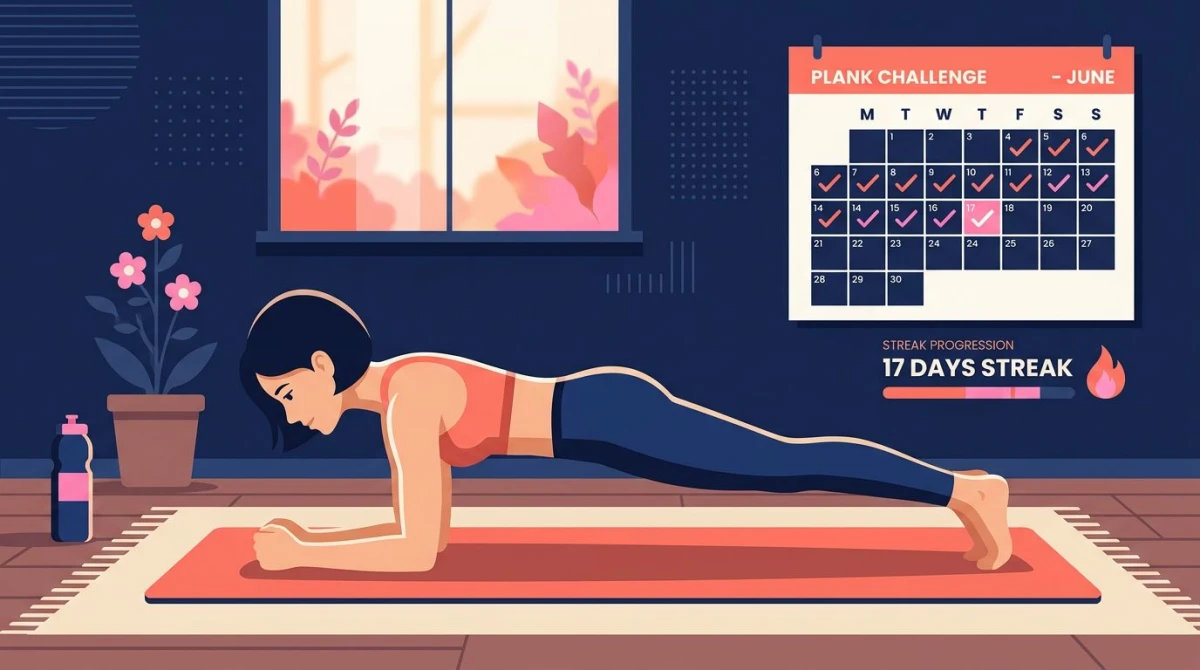
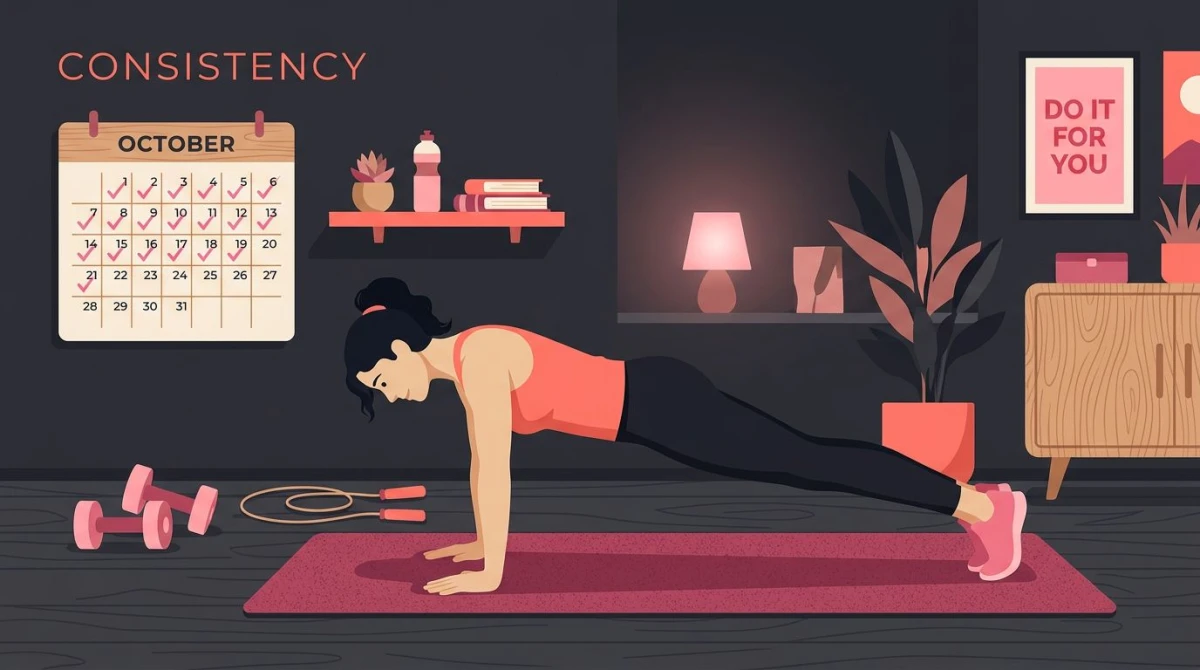
The single biggest predictor of who finishes the 6 weeks is whether they keep a visible streak. Week 1 and 2 are easy. Week 3 is where most people quit — the novelty fades, the rep count climbs, and motivation drops.
A simple streak does most of the psychological work. Cross the day off a calendar, or use a daily habit tracker app. HabitBox shows the streak as a calendar heatmap on iOS and Android. Add "100 pushups" (or your weekly daily target) as a habit, check it off each day, and watch the chain build. The visible chain at day 14 is what gets most people through day 21.
For more on the consistency side, see our piece on fitness consistency and how to make exercise a habit. The pushup program is one of the cleanest applications of those principles — the rep is small, the gear is none, the streak is everything.
What to eat (and when)
You don't need a special diet to do 100 pushups. You do need enough protein and enough sleep. Two practical rules:
- Protein: roughly 0.7 to 1 gram per pound of body weight per day. Most people fall short and wonder why recovery feels slow. Plug in your weight to see how much protein you need.
- Sleep: 7+ hours, consistent timing. Strength gains happen at night, not in the workout. Cut sleep and you cut the gains.
That's it. No special supplements are required. Whey protein after the workout is fine if you don't otherwise eat much protein at breakfast.
Common reasons people stall
A short list of patterns that derail the 6-week program:
- Skipping rest days. Joint overuse compounds across weeks. By week 4, the wrists hurt and the program collapses. Take the one rest day.
- Ego cheats. Half-range reps, hips up, head bobbing. The count goes up, the strength does not, and the form gap shows when you try a clean max-rep test.
- Too many reps to failure in set 1. Burning out on the first set means sets 4 and 5 fall apart. Save 1 to 2 reps in the tank on early sets.
- No warm-up. Cold shoulders + 30 pushups = aggravation by week 3. Two minutes of arm circles, scapular pushups, and shoulder rolls is enough.
- Inconsistent timing. Doing the reps at 11pm one night and 7am the next disrupts the habit. Pick a fixed time. Most people: morning before shower.
- No progression variant. Once you hit 100 standard, switch to incline-feet, diamond, or weighted to keep the strength curve rising. If you only do standard pushups forever, the strength plateaus around week 8.
- Quitting at week 3. The mid-program slump is real. Hold the streak. By week 4 the body adapts and reps get easier again.
How to time your reps each day
A small but real question: should you do all 5 sets in one block, or spread them through the day? Both work. Here is the trade-off.
One block (e.g., 5 sets in 15 minutes after coffee). This is the simplest to track. You either did it or you didn't. The habit is one box on the calendar. Most people do best with this version because the streak is unambiguous.
Spread through the day (e.g., one set every 2 hours). This is the "greasing the groove" approach popularized by Pavel Tsatsouline. Each set is far from failure, total daily volume goes up, and the nervous system gets more reps. It works well if you have a desk job and can drop into a hallway corner for 30 seconds. The downside: harder to track, easier to skip a set.
Beginners: use one block. Intermediates aiming for unbroken 100s: try spreading after week 4. Either way, hit the daily total.
After 100 — what's next
Once you hit 100 a day, you have two reasonable paths:
- Keep 100/day as maintenance and add a variant. Diamond pushups (triceps), wide grip (chest), decline (upper chest), or pike (shoulders). Run a 4-week cycle on one variant.
- Move to weighted or one-arm progressions. Weighted vest pushups, archer pushups, pseudo planche. The strength curve restarts.
Most people stop at "100/day for life" — that alone delivers a noticeably stronger upper body over months. Pair it with a morning workout routine, a 30 day plank challenge schedule for the core work pushups only partly cover, and a running streak and you have a full bodyweight fitness stack.
When the program isn't right for you
Honest disclaimers. Skip this program (or modify with a professional) if you have:
- Shoulder pain or rotator-cuff issues going in. See a PT first.
- Wrist injuries or carpal tunnel. Use pushup handles or do pushups on fists.
- A heart condition or blood pressure issue without doctor clearance.
- A current upper-body injury (collarbone, AC joint, recent surgery).
The program also won't work well if your body weight is at the upper end of the comfortable pushup range. Spend 4 weeks at incline (hands on a bench or counter) to build the base before moving to floor pushups.
And one more: the 6-week timeline is a median. Some people take 4 weeks. Some take 10. If you're 50+ or new to strength work, give it 8 weeks instead of 6 and you'll arrive cleaner.
FAQ
How long does it take to do 100 pushups?
Most untrained adults reach 100 pushups in a day (broken into 5 sets) within 6 weeks of daily training. Hitting 100 pushups in a row (unbroken) takes most people 4 to 12 months of consistent training. The 6-week program above targets the first version. The unbroken version requires additional max-rep specific training.
Is 100 pushups a day too much?
For most healthy adults, 100 pushups broken into 5 sets, 6 days a week with one rest day, is well within the tissue-recovery window. Jeff Cavaliere of AthleanX argues daily 100s without rest can overuse the shoulder and elbow joints, and he has a point. The compromise — 6 on, 1 off — addresses that concern while keeping the daily rep habit.
What happens if I do 100 pushups every day for a month?
Most people see noticeable chest, shoulder, and triceps definition by week 3 and measurable strength gains by week 4. Reported results: 1 to 3 cm chest expansion, easier overhead pressing, and improved posture. Without rest days, around 30 to 40% of people develop shoulder or wrist irritation by week 4 — the smart-rest version above avoids most of that.
How do I do 100 pushups in a row?
Going from 100 pushups broken into 5 sets to 100 in a row is a separate goal. Build it by running the 6-week program first, then doing one max-rep set per day instead of 5 split sets, adding 1 to 2 reps to the max each session. Most who can do 5×20 in one workout reach 100 unbroken in 8 to 16 weeks of dedicated max-rep training.
Do pushups build muscle?
Yes, especially for beginners and intermediates. Pushups train chest, anterior deltoids, triceps, and core. Once you can do 30+ standard pushups in a row, gains slow unless you add resistance (weighted vest, decline angle, archer variations) or volume. For pure size gains beyond intermediate level, barbell or dumbbell pressing typically progresses faster than bodyweight alone.
The bottom line
100 pushups in a day is reachable for most healthy adults in 6 weeks if you keep the form strict, take one rest day a week, and protect the streak. Pick your starting band, run the table, log every day. The visible streak does the motivation work — your job is just to start the first set.
If you want the streak as a calendar heatmap with smart reminders, HabitBox is free to start on iOS and Android, with an optional Plus upgrade — add "100 pushups" as a daily habit and watch the chain build.

Mira Hartwell
Editor, HabitBoxEditor at HabitBox. Writes about habit science and productivity, grounding every post in named research (Lally, Wood, Walker, Huberman) instead of recycled advice. Read full bio →