15 Bad Habits to Quit This Year (2026)
TL;DR: This guide ranks 15 bad habits to quit by impact versus effort, then pairs each one with a specific replacement behavior and a first tracked step. The reason is simple: research shows swapping the routine while keeping the cue and reward is more effective than white-knuckling your way through quitting. Pick one or two from the high-impact tier, track the replacement for 30 days, and let the master table below do the prioritizing for you.
Most "bad habits to quit" lists hand you 25 things you already feel guilty about and leave you to sort it out. That is the wrong order of operations. You do not have the willpower to quit 15 habits at once, and you do not need to. The smart move is to find the one or two habits with the highest payoff, replace them with something specific, and track the new behavior until it sticks.
This list does that ranking for you. Each habit comes with three things competitors skip: why it actually costs you, the replacement habit to install instead, and the first step you can start tracking today.
A quick note on how to read the ranking. Impact is about how far the cost spreads — a habit that drags down your sleep, mood, and focus at once ranks higher than one that only annoys you. Difficulty is about how much effort the swap takes given how deep the cue runs. The best first habit to quit is high-impact and low-difficulty, because an early win builds the confidence you will need for the harder swaps later.
Why "quitting" usually fails and "replacing" works
Here is what the research says about willpower-based quitting: it mostly does not work. When you try to erase a habit by sheer force, you leave a gap. The cue that triggered the old behavior is still there, the reward you were chasing is still unmet, and your brain runs the familiar program anyway.
Charles Duhigg calls the fix the Golden Rule of habit change in The Power of Habit (2012): keep the same cue and the same reward, but swap the routine in the middle. James Clear summarizes the same principle — you don't eliminate a bad habit, you replace it. If stress (cue) sends you to your phone for a hit of distraction (reward), the phone is not the problem. The problem is you have no other routine that delivers that reward.
The American Heart Association reaches the same conclusion in its guide to breaking bad habits: "replacing a bad behavior with a good one is more effective than stopping the bad behavior alone."
There is a second lever, and behavioral scientist Wendy Wood argues in Good Habits, Bad Habits (2019) that it matters more than motivation: friction. Habits are responses to your environment. Make the bad habit harder to start and the good one easier, and you stop relying on discipline you may not have on a tired Tuesday. Move the snack out of the house. Charge your phone in the kitchen. Lay out your gym clothes. For a deeper walk through the loop-disruption method, see our guide on how to break a habit.
So every entry below follows the same shape: cue stays, reward stays, routine changes, friction shifts. That structure is also why a tracker helps more than a resolution — you are not measuring your virtue, you are measuring whether the new routine is firing when the cue does.
The 15 bad habits to quit, ranked by impact
The list runs high-impact first. High-impact habits are the ones whose costs compound across your health, finances, focus, or relationships — quitting these moves the needle most. Within each tier, the easier wins come first so you can build momentum.
High-impact habits
1. Doomscrolling and endless feed-checking. The cost is not just time; it is fragmented attention and a measurable dip in mood after each session. The feed is engineered to keep delivering tiny, unpredictable rewards, which is exactly what makes the loop so hard to break by willpower. Replacement: a single scheduled "news window" plus a different wind-down ritual at night. The cue (boredom, a notification, a quiet moment) stays the same, but the routine changes from infinite scroll to a contained, finished activity. First tracked step — track one phone-free hour before bed. If your scrolling is mostly a stress response, our digital detox challenge gives you a structured 7-day reset.
2. Skimping on sleep. Cutting sleep to gain hours is the worst trade in personal productivity — it taxes mood, focus, immunity, and willpower itself, which makes every other habit on this list harder to change. Sleep sits near the top precisely because it is a keystone: fix it and several other habits get easier without direct effort. Replacement: a fixed wind-down time, not a fixed bedtime. Counting backward from when you want to be asleep is more controllable than ordering yourself to fall asleep on command. First tracked step — track your lights-out time, not your wake time.
3. Sedentary days (sitting for hours). Long uninterrupted sitting is its own risk factor, independent of whether you exercise. You can hit the gym in the morning and still spend ten hours motionless, which is why this earns its own line. Replacement: a movement break each hour and a daily walk. The friction fix is to make movement the default — a standing call, a water glass that empties often enough to force a walk to refill it. First tracked step — track a 10-minute walk after lunch.
4. Negative self-talk. The internal monologue that calls you lazy or a failure is not motivating; it raises stress and erodes the self-belief that habit change depends on. It is also self-fulfilling — if you already believe you are someone who quits, you give yourself permission to quit. Replacement: a brief reframe — name the thought, then state the next small action instead of arguing with the feeling. First tracked step — track one daily "wins" note, three lines max.
5. Mindless snacking. Eating on autopilot in front of a screen adds calories you never registered and dulls real hunger cues, so you eat without ever feeling fed. The screen is the cue and the snack is the routine, which means the fix is mostly environmental. Replacement: a designated eating spot away from screens, plus a pre-portioned alternative within reach. First tracked step — track screen-free meals.
6. Overspending on impulse. Small unplanned purchases quietly drain savings and the goals attached to them, and the sting is delayed enough that you never connect cause and effect. Replacement: a 24-hour rule on non-essentials, which lets the impulse pass, plus one weekly money check-in so the trend stays visible. First tracked step — track a daily no-spend on wants.
Medium-impact habits
7. Chronic time-wasting. Drifting between tabs and "quick checks" eats the hours you meant to spend on what matters. Replacement: time-boxing one focused block per day with the phone in another room. First tracked step — track one 25-minute focus session. Our guide on how to stop wasting time breaks down the triggers.
8. Hitting snooze. Snoozing fractures your last sleep cycle and starts the day in reaction mode. Replacement: alarm across the room and one fixed first action (water, then stretch). First tracked step — track a single feet-on-the-floor time.
9. Procrastinating on the hard task. Putting off the important thing trades a small amount of present discomfort for a larger future one. Replacement: the two-minute version of the task to lower the activation cost. First tracked step — track starting the task, not finishing it.
10. Skipping breakfast or eating chaotically. Irregular eating spikes later cravings and decision fatigue. Replacement: one repeatable default meal you do not have to think about. First tracked step — track a consistent first meal.
11. Constant multitasking. Switching between tasks feels productive but adds errors and switching costs. Replacement: single-tasking with notifications silenced. First tracked step — track one notification-free work block.
12. Saying yes to everything. Poor boundaries leave no room for the habits you actually want, because every yes is a quiet no to your own time. Replacement: a 24-hour pause before committing, which turns an automatic reflex into a deliberate choice. First tracked step — track one "let me check and get back to you" per week.
Lower-impact but worth fixing
13. Nail-biting and other nervous tics. Low stakes, but a visible stress signal. Replacement: a competing response — clench a fist or hold an object when the urge hits. First tracked step — track urge-free stretches.
14. Excessive caffeine late in the day. Afternoon coffee can quietly wreck the sleep that sits at the top of this list. Replacement: a hard caffeine cutoff time, decaf or tea after it. First tracked step — track your last caffeine time.
15. Complaining and grudge-holding. A chronic negative frame colors how you experience everything else. Replacement: a daily gratitude note or one constructive reframe. First tracked step — track one gratitude entry a day.
Master table: what to quit, what to replace, what to track
This is the prioritizing engine of the whole guide. Scan the impact and difficulty columns, find a high-impact habit that looks achievable, and start with its first tracked step.
| Bad habit | Impact | Difficulty | Replacement habit | First tracked step |
|---|---|---|---|---|
| Doomscrolling | High | Medium | Scheduled news window + night ritual | Phone-free hour before bed |
| Skimping on sleep | High | Medium | Fixed wind-down time | Track lights-out time |
| Sedentary days | High | Low | Hourly movement + daily walk | 10-min walk after lunch |
| Negative self-talk | High | High | Name thought, state next action | One daily wins note |
| Mindless snacking | High | Medium | Screen-free eating spot | Screen-free meals |
| Impulse overspending | High | Medium | 24-hour rule on wants | Daily no-spend on wants |
| Time-wasting | Medium | Medium | One time-boxed focus block | One 25-min focus session |
| Hitting snooze | Medium | Low | Alarm across room + first action | Feet-on-the-floor time |
| Procrastinating | Medium | High | Two-minute starting version | Track starting the task |
| Chaotic eating | Medium | Low | One default repeatable meal | Consistent first meal |
| Multitasking | Medium | Medium | Single-task, notifications off | One distraction-free block |
| No boundaries | Medium | High | 24-hour pause before yes | One deferred commitment/week |
| Nail-biting | Low | Medium | Competing response | Urge-free stretches |
| Late caffeine | Low | Low | Hard caffeine cutoff | Last caffeine time |
| Complaining | Low | Medium | Daily gratitude/reframe | One gratitude entry |
How long does it actually take to quit a habit?
Forget the 21-day myth. A University College London study led by Phillippa Lally followed people forming new behaviors and found a median of 66 days to reach automaticity, with a wide range of 18 to 254 days depending on the person and the behavior (Lally et al., 2010). Simpler habits, like drinking a glass of water, automated faster; harder ones took much longer.
The practical takeaway is honest, not discouraging: expect roughly two to three months for a meaningful change to feel automatic, and do not treat a missed day as failure. The same research found that one slip did not measurably derail the overall process. For a deeper breakdown by habit type, see how many days it takes to make a habit.
A simple 30-day plan to quit one bad habit
You do not work the whole list. You work one or two high-impact habits at a time. Here is a 30-day structure that fits the research above.
Week 1 — Observe and set up. Pick one high-impact habit from the table. Identify its cue (when and where it fires) and add friction: move the trigger object, silence the app, rearrange your space. Then choose the replacement and its first tracked step.
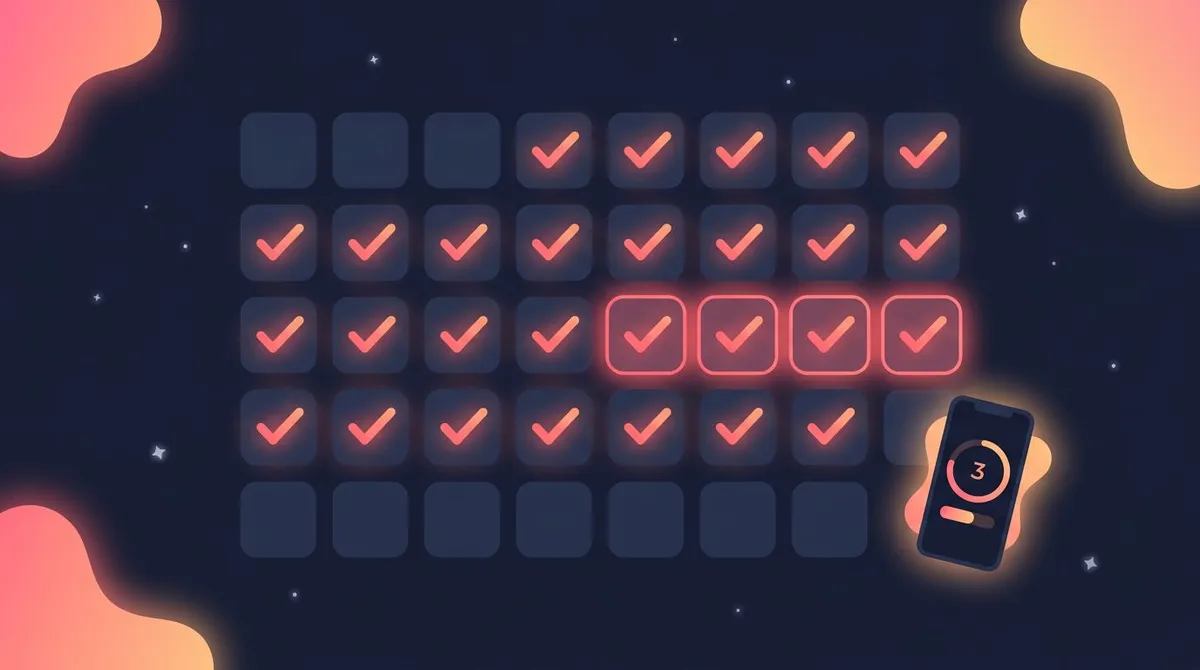
Weeks 2 to 3 — Track the replacement, not the absence. This is the key shift. Do not track "didn't doomscroll" — that is invisible and unrewarding. Track the new behavior: the phone-free hour, the lunchtime walk, the focus session. A streak you can see taps into the same loss-aversion that makes you not want to break a chain. A dedicated tracker like HabitBox makes this easy — log the replacement with one tap, watch the streak build, and check the calendar heatmap to spot the days your cue is strongest.
Week 4 — Reinforce with a reward you control. Pair the new habit with something you enjoy so the habit loop delivers a reward, not just discipline. Listening to a favorite podcast only on your walk is one example of temptation bundling — attaching a want to a should so the routine pays off immediately. By day 30 the behavior will not be automatic yet (remember the 66-day median), but it will have momentum, and momentum is what you are protecting.
If you slip, log the slip and continue. The goal is the trend across 30 days, not a perfect grid.
FAQ
Which bad habit should I quit first?
Is it better to quit or replace a bad habit?
How long does it take to quit a habit?
How do I quit a habit without willpower?
How do I track quitting a habit?

Mira Hartwell
Editor, HabitBoxEditor at HabitBox. Writes about habit science and productivity, grounding every post in named research (Lally, Wood, Walker, Huberman) instead of recycled advice. Read full bio →